The Wallcovering Guide / planning
Wallcovering Fire Ratings: British Standards and Commercial Specification
How reaction-to-fire classes such as B-s1,d0 are read, which standards and guidance apply in England, Wales, Scotland and Northern Ireland, and what makers' documents show for specific commercial wallcoverings.
The short answer
- A wallcovering’s fire rating is a reaction-to-fire class under BS EN 13501-1, such as B-s1,d0. It describes how the product, tested in a stated build-up, contributes to the early growth of a fire. It is not fire resistance, and it does not give a wall any number of minutes.
- The class belongs to the tested build-up: that product, on the substrate and with the adhesive its classification document names, within the variations it permits. A different substrate, adhesive, lining, coating or an old wallcovering underneath can take the installation outside that evidence.
- In England, Approved Document B Volume 2 sets minimum classes by location for buildings other than dwellings: D-s3,d2 for small rooms, C-s3,d2 for other rooms and B-s3,d2 for other circulation spaces, where a wallcovering conforming to BS EN 15102 and achieving at least C-s3,d2 is also acceptable if it is bonded to an A2-s3,d2 substrate (note 1 to the table). Dwellings and blocks of flats, including their common areas, are covered by Volume 1, Table 4.1: its row for other circulation spaces, including the common areas of flats, is also B-s3,d2 with the same wallcovering note, but its rows for small rooms, garages and circulation spaces within a dwelling differ. It is guidance on meeting the legal requirement, and a project’s fire strategy can ask for more.
- Read the full notation. “Euroclass B” without s and d values leaves the smoke and droplet results unknown. “Class 0” is an old British national class, with no automatic European equivalent; England stopped using national reaction-to-fire classes in its guidance from 2 March 2025.
- Wales, Scotland and Northern Ireland have their own guidance, with different tables and, in Wales and Northern Ireland, national classes still printed.
- Who decides depends on the job. For building work, the designer, fire engineer or building-control body decides what each wall needs and whether the evidence is enough. For a building in use where the job is not building work, the responsible person under fire-safety law decides, through the fire risk assessment. That law does not apply inside a private home. The manufacturer declares the product’s performance. We install the specified product as the maker instructs and record what went on the wall.
For preparation, quantities and hanging guides, see the Wallpapering hub. For hotel packages, see fire safety and compliance for hotel wallcoverings.
Reading a classification
A European reaction-to-fire class has up to three parts: the main class (A1 to F), a smoke subclass (s1 to s3) and a flaming droplets subclass (d0 to d2). Read the notation exactly as the document prints it. For classes A2, B, C and D, a smoke or droplet subclass that is not printed is unknown, not assumed. Classes A1 and F carry no subclasses; class E carries no smoke subclass and is followed by d2 only if the filter paper ignited.
| Class | What it means | Basis |
|---|---|---|
A1highest | The highest class. The product passes both the non-combustibility and the calorific-value tests. No smoke or droplet subclass is given. | BS EN ISO 1182 and BS EN ISO 1716. |
A2 | Passes one of the A1 tests to a less strict limit, and the single burning item test to the class B limits. Carries smoke and droplet subclasses. | BS EN ISO 1182 or BS EN ISO 1716, plus BS EN 13823: fire growth rate (FIGRA) up to 120 W/s, lateral flame spread short of the specimen edge, total heat release in 600 s up to 7.5 MJ. |
B | A limited contribution to fire growth in the single burning item test, and limited flame spread from a small flame. | BS EN 13823: FIGRA up to 120 W/s, lateral flame spread short of the specimen edge, total heat release in 600 s up to 7.5 MJ. BS EN ISO 11925-2: 30-second flame, flame spread no more than 150 mm within 60 seconds. |
C | As class B, with higher limits for fire growth and total heat release. | BS EN 13823: FIGRA up to 250 W/s, lateral flame spread short of the specimen edge, total heat release in 600 s up to 15 MJ. BS EN ISO 11925-2: 30-second flame, flame spread no more than 150 mm within 60 seconds. |
D | A higher fire-growth limit in the single burning item test and the same small-flame test as B and C. | BS EN 13823: FIGRA up to 750 W/s. BS EN ISO 11925-2: 30-second flame, flame spread no more than 150 mm within 60 seconds. |
E | Passes a shorter small-flame test only. May carry d2 if the filter paper ignites; no smoke subclass. | BS EN ISO 11925-2: 15-second flame, flame spread no more than 150 mm within 20 seconds. |
Flowest | Assigned when a product fails to attain class E. It is a class, not a blank: different from “no performance determined” and from an untested product. | BS EN ISO 11925-2: 15-second flame, flame spread more than 150 mm within 20 seconds (Delegated Regulation 2016/364, Table 1); England's Approved Document B, Appendix B, paragraph B6. |
| Subclass | What it means | Basis |
|---|---|---|
s1lowest smoke | The lowest smoke production category in the single burning item test. | Smoke growth rate (SMOGRA) up to 30 m²/s² and total smoke production in 600 s up to 50 m². |
s2 | More smoke allowed than s1, still within a limit. | SMOGRA up to 180 m²/s² and total smoke production in 600 s up to 200 m². |
s3no limit set | Neither s1 nor s2: no limit is set for smoke production. | Not s1 or s2. Approved Document B: s3 means no limit is set. |
| Subclass | What it means | Basis |
|---|---|---|
d0none | No flaming droplets or particles in the single burning item test within 600 seconds. | BS EN 13823 observation over 600 s. |
d1 | No flaming droplets or particles that persist for longer than 10 seconds within 600 seconds. | BS EN 13823 observation over 600 s. |
d2no limit set | Neither d0 nor d1: no limit is set for flaming droplets. Also given when the filter paper ignites in the small-flame test. | Not d0 or d1; or paper ignition in BS EN ISO 11925-2. |
Worked examples
B-s1,d0- Class B; s1, the lowest smoke category in the test; d0, no flaming droplets or particles. It describes the tested build-up in the classification document, not the product on any wall.
B-s2,d0- Class B; s2, more smoke allowed than s1 but within a limit; d0, no flaming droplets or particles. The main class and the droplet result match B-s1,d0; only the smoke category differs.
C-s3,d2- Class C with no limit set for smoke or droplets. The class England's Table 6.1 gives for “other rooms”.
Euroclass B- Main class B. The smoke and droplet subclasses are not stated, so they are unknown. Ask for the declaration of performance or classification report, which will state them.
Class 0- Not a European class. A British national classification based on BS 476 tests, no longer used in England's Approved Document B but still printed in the Welsh and Northern Irish guidance. There is no automatic conversion to a European class; see below.
Class definitions: European Commission (text on legislation.gov.uk), Commission Delegated Regulation (EU) 2016/364 on the classification of the reaction to fire performance of construction products (Annex, Table 1); Ministry of Housing, Communities and Local Government, Approved Document B: Fire safety, Volume 2: Buildings other than dwellings (2019 edition incorporating the 2020, 2022, 2025 and 2026 amendments, with the forthcoming 2029 changes; for use in England).
Reaction to fire is not fire resistance
Reaction to fire is how much a product contributes, by its own decomposition, to a fire under specified test conditions. It is what a wallcovering’s class describes: how readily it ignites, how fast it releases heat and spreads flame in the early stages of a fire, how much smoke it gives off in the test and whether it drops flaming particles. England’s Approved Document B uses that definition in Appendix B.
Fire resistance is a different property, measured for building elements: how long a wall, floor, door or ceiling continues to do its job in a fire, for example keeping fire and heat on one side. It is expressed in minutes under a separate classification standard, BS EN 13501-2, with notations such as EI 30 or EI 60. A wallcovering has no fire-resistance period of its own, and hanging one does not give a wall 30, 60 or 120 minutes. If a wall needs fire resistance, that comes from the wall’s construction and its own evidence.
Three more limits are worth stating plainly:
- The smoke subclass is not a toxicity rating. s1, s2 and s3 are bands of how fast and how much smoke the product produced in the single burning item test. They say nothing about how toxic the smoke is. England’s guidance on linings says it does not include guidance on the generation of smoke and fumes, so a smoke requirement, if there is one, comes from the project.
- A class never means “safe anywhere”. A classification is a test result for a defined build-up. Whether it is enough depends on where the product goes and what the project requires. Words such as “fireproof”, “non-flammable” or “zero smoke” on a wallcovering should send you looking for the classification document.
- Class F, “no performance determined” and “unclassified” are three different things. Class F is a class: it is given when a product was tested and did not achieve class E. “No performance determined” (NPD) on a declaration of performance means the manufacturer has not declared a value for that characteristic. “Unclassified” means there is no classification at all, and under Approved Document B an untested product cannot be classified to BS EN 13501-1. The narrow exception is classification without further testing: Commission Decision 2010/82/EU lists certain decorative wallcoverings conforming to BS EN 15102 that may be classed D-s3,d2 without testing, within stated limits of mass and thickness, substrate and adhesive. D-s3,d2 is below what England’s Table 6.1 sets for rooms other than small rooms and for circulation spaces. None of the three should be read as a pass, and none should be read as a known failure beyond what the document says.
The standards behind the classes
A wallcovering’s European class comes from a small family of standards. BS EN 13501-1 is the classification standard: it turns test results into a class. The tests themselves are the single burning item test (BS EN 13823) and a small-flame ignitability test (BS EN ISO 11925-2). The product is mounted for testing on a standard substrate chosen under BS EN 13238, and decorative wallcoverings declare their performance under the product standard BS EN 15102.
Two cautions when reading a document:
- The latest edition is not always the edition that applies. A report or declaration cites the edition used when it was written, and the edition cited for UKCA and CE marking can lag behind BSI’s latest. BS EN 15102 is the clearest case: BSI lists a 2019 edition, while the designated-standards lists and England’s guidance cite 2007+A1:2011. Record what the document cites; do not silently substitute a newer edition.
- A catalogue record is not the standard. We have checked titles, editions and status in BSI’s catalogue. We have not reproduced the paid texts, and nothing on this page should be read as a summary of their clauses.
Under the construction products rules, a declaration of performance states the class the manufacturer declares for the product. Where no value is declared for a characteristic, the declaration shows “NPD”: the regulation spells it out as no performance determined, and some declarations print it as no performance declared. Either way it is not a class and not a pass.
| Standard | What it does | Latest edition we found | Status | Note |
|---|---|---|---|---|
| BS EN 13501-1Fire classification of construction products and building elements. Classification using data from reaction to fire tests | Turns the results of the reaction-to-fire tests into a class (A1 to F) with smoke and droplet subclasses. | BS EN 13501-1:2018Published January 2019 | Current | Some older reports and declarations cite EN 13501-1:2007+A1:2009, which BSI shows as withdrawn in January 2019. A document citing the older edition is not automatically invalid; record the edition it cites and ask the maker if in doubt.BSI record · BSI record |
| BS EN 13823Reaction to fire tests for building products. Building products excluding floorings exposed to the thermal attack by a single burning item (SBI) | The single burning item test: a corner test that measures heat release, lateral flame spread, smoke production and flaming droplets for classes A2 to D. | BS EN 13823:2020+A1:2022Published January 2023 | Current (BSI marks it under review) | BSI shows earlier editions current until these dates: 2002 to October 2010, 2010 to November 2014, 2010+A1:2014 to May 2020, and 2020 to January 2023. A report cites the edition used when the product was tested; record the edition it cites.BSI record |
| BS EN ISO 11925-2Reaction to fire tests. Ignitability of products subjected to direct impingement of flame. Single-flame source test | A small-flame ignitability test used for classes B to F; ignition of the filter paper below the specimen gives the d2 droplet subclass. | BS EN ISO 11925-2:2026Published January 2026 | Current | The 2020 edition was current until January 2026, so almost every report you will see cites 2020 or 2010.BSI record |
| BS EN ISO 1182 and BS EN ISO 1716Non-combustibility test; determination of the gross heat of combustion | Used only for classes A1 and A2. None of the wallcovering reports we read used them. | BS EN ISO 1182:2020; BS EN ISO 1716:2018Published 2020; 2018 | Current | BSI record · BSI record |
| BS EN 15102Decorative wallcoverings. Roll form (2019); previously Decorative wall coverings. Roll and panel form (2007+A1:2011) | The product standard for decorative wallcoverings, under which makers declare reaction to fire. England's Table 6.1 note refers to wallcoverings that conform to it. | BS EN 15102:2019Published June 2019 | Current at BSI; the 2007+A1:2011 edition is the one cited in the GB designated-standards list and the EU list | The edition BSI treats as current (2019) is not the edition cited for UKCA and CE marking (2007+A1:2011), and Approved Document B also lists 2007+A1:2011. Declarations of performance normally cite 2007+A1:2011. Do not read one as the other.BSI record · BSI record · Ministry of Housing, Communities and Local Government record · European Commission record |
| BS EN 13238Reaction to fire tests for building products. Conditioning procedures and general rules for selection of substrates | Sets the standard substrates products are tested on, which is why a classification names a substrate and holds only for substrates it represents. | BS EN 13238:2026Published July 2026 | Current (the 2010 edition was withdrawn in August 2026) | Approved Document B still lists the 2010 edition, and existing reports cite 2010.BSI record · Ministry of Housing, Communities and Local Government record |
| BS EN 15725Extended application on the fire performance of construction products and building elements | Principles for extended-application reports, which assess whether a result can be extended beyond the tested build-up. England's guidance points to it. | BS EN 15725:2023Published March 2023 | Current | Approved Document B lists the 2010 edition.BSI record |
| BS EN 13501-2Fire classification of construction products and building elements. Classification using data from fire resistance and/or smoke control tests | Fire resistance of building elements, in minutes (for example EI 30). Not a wallcovering standard; listed here to keep the two ideas apart. | BS EN 13501-2:2023Published June 2023 | Current (BSI marks it under review) | BSI record |
| BS 476-6 and BS 476-7Fire tests on building materials and structures: fire propagation (Part 6); surface spread of flame (Part 7) | The British national tests, now withdrawn by BSI, behind Class 1 to 4 (Part 7) and the fire-propagation route to Class 0 (Parts 6 and 7); Class 0 could also be met by materials of limited combustibility. | BS 476-6:1989+A1:2009; BS 476-7:1997Published 1989; 1997 | Withdrawn by BSI on 4 March 2025 | Removed from England's Approved Document B from 2 March 2025; still referred to in the Welsh and Northern Irish guidance.BSI record · BSI record · BSI record |
Class 0, ASTM, IMO and other systems
Class 0 and Class 1
Before the European classes, British guidance used national classes based on BS 476. Class 1 to Class 4 were surface spread of flame results under BS 476 Part 7, Class 1 being the best. Class 0 was not a test result of its own. The guidance defined it: a material of limited combustibility throughout, or a Class 1 material that also met fire propagation limits under BS 476 Part 6 (an index I of no more than 12 and a sub-index i1 of no more than 6). That definition was printed in earlier editions of England’s Approved Document B and is still printed in the Welsh Approved Document B (Appendix A, paragraph 13) and Northern Ireland’s Technical Booklet E.
There is no automatic conversion between national classes and European classes. England’s guidance said so while it still listed the national classes: products could not typically assume a European class unless they had been tested for it, and where a smoke or droplet performance was specified, only European classes could be used. Wales and Northern Ireland still print the first of those warnings beside their linings tables. A data sheet that says “Class 0” and nothing else is not evidence of any European class.
England removed the national reaction-to-fire classes from its guidance from 2 March 2025, subject to transitional arrangements. BSI shows BS 476 Parts 6 and 7 as withdrawn from 4 March 2025. Neither step, in the documents we read, declares older BS 476 reports invalid; it means the current English guidance is written in European classes only.
ASTM, IMO and other systems
Some makers sell internationally and print several results side by side. Read each one in its own system:
- ASTM E84 is a United States tunnel test that reports a flame spread index and a smoke developed index; makers often summarise a result as “Class A”. That is not a European class, and US Class A is not class A1 or A2.
- IMO FTP Code Part 5 is a marine surface-flammability test for ships, with its own criteria. A marine approval is not a building classification.
- Furniture and curtain tests, such as BS 5852 for upholstered seating, BS 5867 for curtain fabrics or BS EN 13773 for curtains and drapes, are not evidence for a wallcovering, even when the same textile is used.
For a British project, look for the European classification under BS EN 13501-1 and the build-up it covers. The other results can be useful context; they do not stand in for it.
Sources: Ministry of Housing, Communities and Local Government, Approved Document B: Fire safety, Volume 2, 2019 edition incorporating the 2020 amendments and the 2022 amendments (superseded) (Superseded edition), Appendix B, Table B1 and notes, printed pp. 137–138; Welsh Government, Approved Document B, Volume 2: Buildings other than dwellinghouses (for use in Wales) (2006 edition incorporating the 2010, 2013, 2016, 2017 and 2020 amendments), Appendix A, paragraph 13, p. 199; Table 10 note 3, p. 103; Department of Finance and Personnel (Northern Ireland), Technical Booklet E: Fire safety (October 2012), paragraph 3.4, p. 74; Table 3.1 note 2, p. 78; ASTM International, ASTM E84-26a: Standard Test Method for Surface Burning Characteristics of Building Materials (ASTM E84-26a); International Maritime Organization, Resolution MSC.307(88): International Code for Application of Fire Test Procedures, 2010 (FTP Code) (Part 5), Annex 1, Part 5.
Applying the guidance in England
For buildings other than dwellings in England, the starting point is Approved Document B, Volume 2. Blocks of flats, including their common corridors and stairs, are covered by Volume 1 instead; its Table 4.1 also sets B-s3,d2 for the common areas of blocks of flats, with the same BS EN 15102 wallcovering note, and C-s3,d2 for circulation spaces within a dwelling. It gives guidance on meeting requirement B2 of the Building Regulations 2010, which is the legal requirement. B2 says internal linings must adequately resist the spread of flame over their surfaces and, if ignited, have a rate of heat release or fire growth that is reasonable in the circumstances.
Three things follow from how the document is built:
- The law is the requirement; the Approved Document is guidance. Following the guidance is one way to show the requirement is met, but it does not guarantee compliance in every case. Under section 7 of the Building Act 1984, not following an approved document does not by itself make anyone liable, but it can be relied on as tending to show a breach, and following it as tending to show compliance. A designer can meet B2 another way, for example through a fire-engineered strategy agreed with the building-control body, which decides whether it is satisfied.
- Section 6 and Table 6.1 set minimum classes by location. The table is short and the categories matter: small rooms (up to 4 m² in residential accommodation, up to 30 m² in non-residential accommodation), other rooms, and other circulation spaces. A hotel bedroom, a meeting room, a corridor and a protected stair are not the same location.
- The table’s own note matters for wallcoverings. Note 1 to Table 6.1, on the circulation-space row, says that wallcoverings conforming to BS EN 15102, achieving at least class C-s3,d2 and bonded to a class A2-s3,d2 substrate, will also be acceptable. That is a route that depends on both the product and what it is bonded to. It is not a rule that any class C wallcovering will do in a corridor.
Read these alongside the table:
- Paragraph 6.4. Parts of walls in rooms may be of lower performance than the table, but no worse than D-s3,d2, and the total area is limited (less than half the room’s floor area, up to 20 m² in residential and 60 m² in non-residential accommodation). This applies to rooms, not circulation spaces.
- What counts as a wall or a ceiling. Paragraphs 6.2 to 6.6 define them. Glazing and steep ceilings count as wall; doors, frames, skirtings, architraves and fitted furniture do not.
- Other sections. Paragraph 6.12 points to the guidance for escape stairs, firefighting shafts and surfaces above fire-protecting suspended ceilings. The project’s fire strategy or the client’s brief may also set higher classes than the table.
- Smoke and droplets. The table’s classes all carry s3 and d2, the least demanding subclasses. B2’s guidance does not address the generation of smoke and fumes. A project can still ask for s1 or d0, so check the specification rather than assuming the table is the whole requirement.
- Appendix B. Test evidence must suit the intended use. Small differences such as the fixing method, joints, air gaps or insulation can significantly affect performance and should be tested or assessed, an assessment following the relevant extended-application standard or the principles of BS EN 15725 and being carried out by an organisation with the necessary expertise; and a reaction-to-fire classification is valid only within its direct field of application: on a substrate of the class it was tested on, with a density of at least 75 per cent of the standard substrate’s. Paragraph B9 adds that standard calcium silicate board is not representative of gypsum plasterboard, because of the paper layer, though it represents most gypsum plasters over 650 kg/m³, and that a classification obtained on plasterboard is also acceptable on gypsum plaster. Much of the product evidence below was obtained on calcium silicate or fibre-cement board.
Who resolves applicability: for building work, the designer or fire engineer for the project, with the building-control body that will approve the work. If that work makes a significant change to a building in use, the responsible person must also review the fire risk assessment (Fire Safety Order, article 9(3)). For redecorating a building in use that is not building work, there is no building-control approval: the responsible person decides, through the fire risk assessment (see below).
| Location | Detail | European class |
|---|---|---|
| Small rooms | Internal floor area of up to 4 m² in residential accommodation, or up to 30 m² in non-residential accommodation | D-s3,d2 |
| Other rooms | Including garages | C-s3,d2 |
| Other circulation spaces | See note 1 below for wallcoverings | B-s3,d2 |
- Note 1 to the table (on the circulation-space row): wallcoverings conforming to BS EN 15102, achieving at least class C-s3,d2 and bonded to a class A2-s3,d2 substrate, are also acceptable.
- Paragraph 6.4: parts of walls in rooms may be of lower performance, but no worse than D-s3,d2, with the total lower-performance area less than half the room's floor area and no more than 20 m² (residential) or 60 m² (non-residential).
- Paragraphs 6.2 to 6.6 define what counts as a wall and a ceiling; paragraph 6.12 points to further guidance for escape stairs, firefighting shafts and surfaces above fire-protecting suspended ceilings.
- s3,d2 in the table means no limit is set for smoke production or flaming droplets (Appendix B, paragraph B7). A project may still specify a stricter subclass.
- This is guidance on one way of meeting requirement B2. The project's fire strategy, designer or building-control body may require more.
Source: Ministry of Housing, Communities and Local Government, Approved Document B: Fire safety, Volume 2: Buildings other than dwellings (2019 edition incorporating the 2020, 2022, 2025 and 2026 amendments, with the forthcoming 2029 changes; for use in England), Requirement B2 and Section 6, printed pp. 54–60 (Table 6.1, note 1 and paragraph 6.4 on p. 55); Appendix B, paragraphs B1 to B9, printed pp. 138–139; paragraph 0.9 (guidance for existing buildings), printed p. 3.
What changed in 2025, and what comes in 2029
Two separate changes to England’s Approved Document B are often run together. They concern different things and take effect on different dates.
2 March 2025: national classes for reaction to fire removed. The 2025 amendments, published in September 2024, deleted the national reaction-to-fire classifications from Approved Document B. Those were the transpositions to British national classes in Appendix B, Table B1 of the previous edition, based on BS 476 Part 7 surface spread of flame (Class 1 and Class 3), Part 6 fire propagation indices and Part 11 non-combustibility. That edition no longer used the label “Class 0”, although its national criteria for B-s3,d2 matched the fire-propagation route to the old Class 0. From that date the guidance for linings is expressed only in European classes under BS EN 13501-1. The previous edition still applies to work where a building notice, initial notice or full plans application was made before 2 March 2025 and the work started and was sufficiently progressed before that date or within six months of it.
2 September 2029: national classes for fire resistance to be removed. A separate set of amendments, also published in 2024, removes the national fire-resistance classifications (BS 476 Parts 20 to 24) in favour of the European fire-resistance classes. These are about walls, floors, doors and other elements resisting fire for a period, not about wallcoverings. They take effect on 2 September 2029, with a similar transitional arrangement.
The consolidated Volume 2 on GOV.UK prints the 2029 changes alongside the current text and marks them as forthcoming. A printed amendment is not necessarily in force: check the date it takes effect. As checked on the date at the top of this page, the 2029 changes were not yet in force.
The 2026 amendments, in force from 30 September 2026, concern stairs and evacuation lifts in blocks of flats and do not change the lining classes.
Wales, Scotland and Northern Ireland
Building regulations are devolved. The four systems use the same European classes, but their tables, notes and amendment dates differ, and none of them applies in the others. Check the guidance for the place where the building is.
- Wales has its own Approved Document B, still based on the 2006 edition with Welsh amendments. Its linings table lists a national class (3, 1 or 0) beside each European class and carries a BS EN 15102 wallcovering note like England’s. Wales did not follow England’s March 2025 removal of national reaction-to-fire classes; the Welsh Government has said they will move to an appendix at a future revision. Since 1 July 2026 Wales also has dutyholder and competence duties for building work and a procedure for higher-risk buildings (Building etc. (Amendment) (No. 2) (Wales) Regulations 2025 and Building (Higher-Risk Buildings Procedures) (Wales) Regulations 2025). These change procedures and duties, not the lining classes. In Wales, a higher-risk building (for design and construction) is at least 18 m high or has at least seven storeys. It must also contain at least one residential unit, a hospital with an overnight bed, a care home or a children’s home. A building that is entirely a hotel is excluded.
- Scotland uses the building standards technical handbooks, one for domestic and one for non-domestic buildings. The non-domestic handbook’s linings table is arranged by building group and by protected or unprotected zone, and uses European classes only. In both handbooks (clause 2.5.1), wall and ceiling surfaces mean the substrate or lining material and exclude decorative wallpaper and paints. Neither handbook defines “decorative wallpaper”. Where the work needs a building warrant, agree with the verifier whether a commercial wallcovering, fabric system or panel counts as decoration or as part of the lining. Work that needs no warrant must still meet the building regulations: no verifier checks it, and the owner or client has the duty to comply. In a hotel, office or other building covered by fire-safety law, the fire risk assessment should also take it into account. The main fire-safety duties exclude homes and the shared stairs and passages of flats, although a narrow duty to maintain facilities for firefighters still applies to the shared parts. The same clause says multiple layers can increase flame spread and are not recommended when redecorating.
- Northern Ireland uses Technical Booklet E. Its table gives both national and European classes by purpose group, room size and circulation space, and it has no separate wallcovering note.
In Wales and Northern Ireland, where national classes are still printed, the guidance itself says national and European classes do not automatically equate. Wales applies the Building Regulations 2010 as amended for Wales, with its own approved documents; Scotland and Northern Ireland have their own building regulations.
| Jurisdiction | Guidance | Wall and ceiling linings | National classes | Dates |
|---|---|---|---|---|
| England | Approved Document B, Volume 2 (Volume 1 covers dwellings, including blocks of flats and their common areas)2019 edition incorporating the 2020, 2022, 2025 and 2026 amendments, printed with the forthcoming 2029 changes | Requirement B2; Section 6 and Table 6.1 give minimum European classes by location, with a BS EN 15102 note for wallcoverings in circulation spaces. Volume 1, Table 4.1, sets the same B-s3,d2, with the same note, for the common areas of blocks of flats. | National reaction-to-fire classes (BS 476 Parts 6, 7 and 11) removed from the guidance from 2 March 2025, subject to transitional arrangements. National fire-resistance classes are due to be removed from 2 September 2029. |
|
| Wales | Approved Document B, Volume 2 (Welsh edition), with Volume 1 for dwellinghousesVolume 2: 2006 edition incorporating the 2010, 2013, 2016, 2017 and 2020 amendments. Volume 1: 2006 edition incorporating the 2010, 2016 and 2020 amendments. Both are for use in Wales. An amendment slip in force from 20 December 2025 replaces the external-wall guidance and adds fire-service provisions for blocks of flats (wayfinding signage, evacuation alert systems, secure information boxes). It does not change Volume 2's Section 7 or Table 10. | Requirement B2; Section 7 and Table 10 give both a national class and a European class for small rooms, other rooms, circulation spaces within dwellings, and other circulation spaces including the common areas of blocks of flats (Welsh Volume 2 covers flats). Note 5, on the circulation-space row, accepts BS EN 15102:2007 wallcoverings of at least C-s3,d2 bonded to an A2-s3,d2 substrate. | Kept: Table 10 still lists national classes 3, 1 and 0 beside the European classes, and Appendix A still defines Class 0. The Welsh Government has said national classes will move to an appendix at the next revision; no date has been set. |
|
| Scotland | Building standards technical handbooks: non-domestic (linings table below) and domesticApril 2026 handbooks (both published 9 March 2026), for building warrants submitted on or after 6 April 2026 and for building work that needs no warrant started on or after that date | Non-domestic handbook: Standard 2.5 and Table 2.4 give European classes by building group (residential care buildings and hospitals, shops, all other buildings) and by location (rooms up to and over 30 m², unprotected zones, and protected zones and fire-fighting shafts). Domestic handbook: protected zones A1, A2 or B; rooms, unprotected zones and protected enclosures no worse than C; small rooms and limited wall areas D (clause 2.5.1). In both, clause 2.5.1 defines wall and ceiling surfaces as the substrate or lining material, excluding decorative wallpaper and paints, and says multiple layers can increase flame spread and are not recommended when redecorating. | Not used for linings: reaction-to-fire classification uses European classes only (Annex 2.E, Table 2.20). The non-domestic handbook still accepts national BS 476 tests for fire resistance (Annex 2.D, clause 2.D.4, BS 476 Parts 20 to 24) and for roof coverings (Annex 2.F, BS 476-3). Where the non-domestic handbook gives a lining class without subclasses, s3,d2 is deemed included (Annex 2.E). |
|
| Northern Ireland | Technical Booklet E: Fire safetyOctober 2012 booklet as amended by AMD 7 (1 April 2022) and AMD 9 (6 May 2025) | Regulation 34; Section 3 and Table 3.1 give both national and European classes by purpose group, room size and circulation space. There is no BS EN 15102 wallcovering note. | Kept: Table 3.1 lists national classes (3, 1 and 0) beside European classes, and the booklet still defines Class 0 by reference to BS 476. |
|
New work, refurbishment and occupied buildings
The lining classes in building-regulations guidance apply to building work: a new building, an extension, a material change of use, or work to an existing building that needs to meet the regulations. Settle before work starts whether a refurbishment counts as building work and, if it does, which edition of the guidance applies. The designer, if there is one, or a building-control body can advise. The answer decides who approves the linings: the building-control route, or the responsible person. Approved Document B lists installers among those responsible for building work, so we raise the question rather than assume the answer.
Buildings in use. Fire-safety law for buildings in use applies to most premises other than private homes. On this page, “a building in use” means one that this law covers. In England and Wales that is the Regulatory Reform (Fire Safety) Order 2005, which requires the “responsible person” to carry out and keep under review a suitable and sufficient fire risk assessment and to take general fire precautions. It does not apply inside a private dwelling (article 6(1)(a)). In a building with two or more homes it does apply to the common parts, such as shared halls, corridors and stairs. The Fire Safety Act 2021 confirmed that the Order also covers the structure, the external walls and the doors between each flat and the common parts (article 6(1A)). That change came into force in Wales on 1 October 2021 and in England on 16 May 2022.
Scotland and Northern Ireland have their own law: Part 3 of the Fire (Scotland) Act 2005 and Part 3 of the Fire and Rescue Services (Northern Ireland) Order 2006. Both require an assessment of fire risks and fire-safety measures, and neither applies to domestic premises. In both, the stairs, passages and other parts shared by the occupants of more than one home count as domestic premises (section 78(4); article 50(6)). So the common parts of a block of flats are outside the main duties there. Only a narrow duty to maintain facilities for firefighters applies to them (regulation 24 of the Fire Safety (Scotland) Regulations 2006 and of the Fire Safety Regulations (Northern Ireland) 2010). The duties do apply to houses in multiple occupation that need a licence in Scotland, and to all houses in multiple occupation in Northern Ireland.
When redecorating is not building work. In England and Wales, redecorating on its own is not normally building work: the linings requirement (B2) is not one of the requirements that make an alteration “material” (Building Regulations 2010, regulation 3). Where the job is not building work, no building-control body approves it. The responsible person decides, through the fire risk assessment, often with a fire risk assessor. Inside a private home these duties do not apply, so there is no responsible person. Approved Document B warns that guidance for assessing existing buildings is often less demanding than guidance for new buildings, so it is unlikely to suit building work. See England’s Volume 2, paragraph 0.9, and the Welsh Volume 2, paragraph 0.19. Where the job is building work, such as an extension, a material change of use or a fit-out that counts as building work, the classes come from the building-regulations guidance or the project’s fire strategy.
In Scotland, replacing a wall lining or covering with one of the same general type needs no building warrant, so no verifier checks it. The work must still leave the standard no worse than before (Building (Scotland) Regulations 2004, regulation 5 and schedule 3, type 25). The owner or client has that duty. Other lining work in a building open to the public, such as a hotel, may need a warrant. In Northern Ireland, “building work” includes a “structural alteration”: any work the regulations would control in a new building. Internal linings are controlled there (Building Regulations (Northern Ireland) 2012, regulations 2 and 34), so ask the district council’s building control whether a wallcovering job needs an application before assuming it does not.
The official risk-assessment guides for England and Wales discuss wall and ceiling linings as part of that assessment. The guide for hotels and other sleeping accommodation says care is needed with multi-layer decorative systems such as wallpapers and oil-based paints; the offices-and-shops guide lists linings by national class and notes that additional finishes may harm a surface’s fire performance. Both are older documents and use the national class names alongside a note that the European equivalent is acceptable.
None of the official sources we checked sets a universal requirement to strip out and replace existing wallcoverings because the classification system has changed. What they do require is an assessment of the actual building. When a hotel or office is being refurbished, the new wallcovering’s evidence, the existing layers underneath and the location of each wall all belong in that assessment.
What makers’ documents show
We read the fire documents that Muraspec, Tektura, Vescom, Arte International and Newmor publish for a selection of their commercial wallcoverings. The table shows one row per product or product family, the class exactly as printed, the kind of document it comes from, the build-up behind it and the gaps we found. It is not a list of approved products, and a row says nothing about a maker’s other products.
What the documents showed, across all five makers:
- The class is tied to a test board. Most declarations and reports name fibre-cement or calcium silicate board and a particular adhesive. Several limit the result to dense mineral boards, and some expressly exclude paper-faced plasterboard. Check the substrate line before assuming a class applies to your wall.
- Classes differ by product. In the table, Muraspec, Tektura and Arte each show products at class C or D; the Vescom and Newmor rows are class B, with different smoke subclasses. A collection name or brand is not a classification.
- Sheets and declarations do not always agree. We found technical sheets that give a class without subclasses, product pages that give a different class from the sheet, declarations that cite a report with a different number or class, and older and newer declarations that give different smoke subclasses for the same product type. Where two documents disagree, the row shows both.
- The type of document matters. A declaration of performance or a classification report from a named laboratory carries more weight than a technical sheet or a web page, which usually gives no test details at all. For some products only a sheet was published.
- Dates are printed in different ways. Some certificates and reports state a validity date; a few of those dates have passed. Others state no period. We record what each document says and flag a printed date that has passed; we do not invent one where none is given.
Before ordering, ask the maker for the current declaration of performance and the classification report for the exact product and backing, and check that the substrate and adhesive in that report match the wall you have.
| Product | Construction | Classification as printed | Evidence | Tested build-up and conditions | Gaps and cautions |
|---|---|---|---|---|---|
| MuraspecFabric-backed vinyl, Type II, 460 gsm (woven and non-woven backings)Declaration of performance CPR0003, version 4 (July 2025)The two 460 gsm Type II product types listed in the declaration. No product codes or colourways are listed; Muraspec says the product code is on the packaging. | Vinyl on woven or non-woven fabric backing, Type II460 gsm | B-s2, d0 on fibre cement board attached with Murabond heavy adhesiveRead as: B-s2,d0Cites EN 13501-1 (edition not printed) |
|
|
|
| MuraspecFabric-backed vinyl, woven Type I, 360 gsmDeclaration of performance CPR0004, version 1 (September 2024)One product type at 360 gsm. The product code is on the packaging; no colourways are listed. | Vinyl on woven fabric backing, Type I360 gsm | Class B, s1, d0 (on fibre cement board using Murabond heavy adhesive) (CPR0004); overlapping CPR0001: B-s2, d0 (on fibre cement board using murabond heavy adhesive)Read as: not resolved: the documents disagree (see gaps)Cites EN 13501-1:2018 |
|
|
|
| MuraspecDigitally printed fabric-backed vinyl on non-woven, 300 gsm and 350 gsm bases (Digi Print 1.1 and 2.1)Declaration of performance CPR0003, version 1 (September 2024)Two digitally printed base types, each with its own laboratory report number. The declaration says nothing about print coverage, inks or bespoke artwork. | Digitally printed vinyl on non-woven fabric backing300 gsm; 350 gsm | Class B, s2, d0 (on fibre cement board using Murabond heavy adhesive)Read as: B-s2,d0Cites EN 13501-1:2018 |
|
|
|
| MuraspecRotary-screen printed non-woven, non-PVC, 200 gsmDeclaration of performance CPR0005, version 1 (September 2024)One product type at 200 gsm. The product code is on the packaging. | Printed non-woven, PVC-free200 gsm | Class B, s1, d0 (on fibre cement board using Murabond heavy adhesive)Read as: B-s1,d0Cites EN 13501-1:2018 |
|
|
|
| MuraspecPaper-backed vinyl, 220 to 300 gsmDeclaration of performance CPR0003, version 4 (July 2025)One product type covering 220 to 300 gsm. No product codes are listed. | Vinyl on paper backing220–300 gsm | B-s2, d0 on fibre cement board attached with Murabond heavy adhesiveRead as: B-s2,d0Cites EN 13501-1 (edition not printed) |
|
|
|
| MuraspecBuflon Mousse Anafi acoustic foam vinyl (BM-61527103)Product web pageThe one product page, which lists 20 colourways. | Foam vinyl on polyester non-woven backing (acoustic)580 gsm | Euroclass C S3 D0 certificationRead as: C-s3,d0 |
|
|
|
| TekturaTektura Studio digitally printed wallcovering: Geometrics designsTechnical specification sheet (undated; the file name refers to 2024)Geometrics designs printed on the Tektura Studio commercial vinyl described on the sheet. The sheet is a combined document that also covers window graphics and acoustic panels; only the wallcovering line is used here. | Digitally printed vinyl laminated onto woven or non-woven fabric backingFrom 350 gsm | Euro classification B when adhered to suitable substrate. (UK) Class 0 and 1 to BS476 part 6 and 7 when adhered to a suitable substrate. Marine fire rated on requestRead as: B (smoke and droplet subclasses not stated) |
|
|
|
| TekturaDimity WeaveTechnical specification sheetThe Dimity Weave product named on the sheet. | Vinyl laminated onto woven cotton backing350 gsm | Euroclass 13501, B s1 d0 / On request : IMO 2010 FTP part 2 - 5Read as: B-s1,d0Cites 13501 (edition not printed) |
|
|
|
| TekturaRivuletTechnical specification sheetThe Rivulet product named on the sheet. | Vinyl laminated onto woven cotton backing350 gsm | Euroclass 13501, B s2 d0 / On request : IMO 2010 FTP part 2 - 5Read as: B-s2,d0Cites 13501 (edition not printed) |
|
|
|
| TekturaShimmy (PVC-free woven)Technical specification sheet (undated; file uploaded August 2025)The Shimmy product named on the sheet. | Polyethylene and olefin weave on acrylic backing, PVC-free375 gsm | Euroclass EN13501, C-s1-d0Read as: C-s1,d0Cites EN13501 (edition not printed) |
|
|
|
| TekturaTempleTechnical specification sheet (undated; file uploaded August 2026) and product web pageThe Temple product. | Vinyl laminated onto polycotton woven backing450 gsm | Euroclass B (technical sheet); Euroclass C (product page)Read as: not resolved: the documents disagree (see gaps) |
|
|
|
| TekturaTiburon ShagreenTechnical specification sheet (undated; file uploaded August 2026)The Tiburon Shagreen product named on the sheet. | Vinyl laminated onto polycotton Osnaburg backing475 gsm | Euroclass B / Class 0 and 1 to BS476 part 6 and 7 when adhered to a suitable substrate.Read as: B (smoke and droplet subclasses not stated) |
|
|
|
| VescomVinyl wallcovering, 350 g/m², plain white, not embossedClassification report 2023-Efectis-R000709 (August 2023); declaration of performance DOP-CPR-01006One plain white, non-embossed 350 g/m² vinyl as tested. Vescom files the same report under four printed (+print) design names, which the report does not describe. | Vinyl on woven cotton backing, 0.45 mm350 g/m² | B - s1, d0Read as: B-s1,d0Cites EN 13501-1:2018 |
|
|
|
| VescomCotton-backed vinyl wallcovering, FR treated, 360 to 850 g/m² (family declaration)Declaration of performance DOP-CPR-01001 (August 2024); certificate 0493-CPR-W014A mass range, not one design. The certificate annex lists Vescom vinyl wallcoverings and digitally printed vinyl. | Vinyl on cotton backing360–850 g/m² (declaration); 350–800 g/m² (certificate) | EN 13501-1 B-s2, d0Read as: B-s2,d0Cites EN 13501-1 |
|
|
|
| VescomColour Choice+Protect (1126.01 PRO to 1126.75 PRO)Product page and specsheet; Protect family declaration DOP-CPR-01002 and certificate 0493-CPR-W015; linked report DO-18-015975 colourways with the PRO suffix, which carry the Protect film. | Plain vinyl on woven cotton backing with Vescom Protect filmAbout 460 g/m² | EN 13501 , B, s2 - d0Read as: B-s2,d0Cites EN 13501 (edition not printed) |
|
|
|
| VescomPorak+print (1041)Classification report 2024-Efectis-R001444 (January 2025)Porak+print as tested, in any colour with or without print. | 40% recycled polyester weave coated on both sides with acrylate, FR treated, 0.35 mm330 g/m² | B - s2, d0Read as: B-s2,d0Cites EN 13501-1:2018 |
|
|
|
| VescomWoven textile on paper backing, silk, wool and synthetic fibres (family declaration DOP-CPR-13004; tested quality 69-2341)Classification report 22965F (October 2023)Only the tested quality, colour and weave. The report was issued to the textile producer, Tapetex BV, and is in Vescom’s document library; Vescom’s declaration for this fibre family cites it. | Woven silk, wool, polyester and nylon on a reinforced paper backing, 0.4 mm305 g/m² | B - s1, d0Read as: B-s1,d0Cites EN 13501-1:2018 |
|
|
|
| VescomDigitally printed one-layer non-woven (cellulose and polyester fibres)Declaration of performance DOP-CPR-13008 (January 2023)A generic product type; the product type reference is on the roll labels. | Digitally printed one-layer non-woven, cellulose and polyester fibres | EN 13501-1 B-s1, d0Read as: B-s1,d0Cites EN 13501-1 |
|
|
|
| Arte InternationalMoire Sauvage (Arte Contract), contract vinyl type 07AReferences 47253A, 47254A, 47258A, 47260A, 47261A, 47264A, 47265A, 47269A and 67700 to 67705The 14 Moire Sauvage references listed in the declaration. Not other Arte Contract designs, although the certificate groups them in one family. | Vinyl on non-woven backing, Type IIAbout 460 g/m² (as printed on the specification sheet) | B-S2,d0 (declaration of performance); B-s2, d0 (specification sheet)Read as: B-s2,d0Cites EN 13501-1 (edition not printed) |
|
|
|
| Arte InternationalDots (Le Corbusier collection), type 01References 31000 to 31039 (40 colourways)The 40 Dots references listed in the declaration. The group classification report also lists other Arte collection names. | Wallpaper on non-woven backing with relief ink dots | B-S1,d0Read as: B-s1,d0Cites EN 13501-1 (edition not printed in the declaration) |
|
|
|
| Arte InternationalIndienne, type 03 vinyl wallpaper (Poona, Agra, Mandu, Bundi, Kerala and Kashmir)References 18300–18303, 18310–18313, 18320–18322, 18330–18333, 18340–18351 and 18360–18371 (39 references, as listed in the declaration)The six Indienne designs listed in the declaration. The group report also lists other collections. | Vinyl with water-based ink (backing not stated in the documents read)The group report covers about 250 to 610 g/m² | B-s2,d0Read as: B-s2,d0Cites EN 13501-1:2019 (report 19/720); no edition in the declaration |
|
|
|
| Arte InternationalLes Tapisseries: Brocade and Ramage, type 06D textileReferences 97840 to 97842 and 97830 to 97832The Brocade and Ramage references in the declaration. | Textile wallcovering (backing not stated in the documents read)The group report covers 580 to 800 g/m² | C-s1,d0 (DoP); C - s1, d0 (report)Read as: C-s1,d0Cites EN 13501-1:2007+A1:2009 (report 20/1150); no edition in the declaration |
|
|
|
| Arte InternationalLes Tapisseries: Collines, type 06C textileReferences 97900 to 97902The Collines references in the declaration. | Non-woven substrate with fabric (classification report)The group report covers 370 to 1,000 g/m² | D - s1, d0 (classification report, June 2026); C-s1,d0 (declaration of performance, April 2026)Read as: not resolved: the documents disagree (see gaps) |
|
|
|
| NewmorPremier vinyl, 460 g/m², non-woven backingClassification report 082/BW/22 (September 2022)The Premier non-woven construction as tested (one colour). | Vinyl 370 g/m² on non-woven 90 g/m², about 0.40 mm460 g/m² | B–s1, d0Read as: B-s1,d0Cites PN-EN 13501-1:2019-02 |
|
|
|
| NewmorPremier vinyl, 400 g/m², non-woven backingTest report 27/06068B/01/23 (February 2023)One sample as tested. | Vinyl on non-woven backing400 g/m² (sample name) | B, s2, d0 (results table); comment: 'probable Class B, s1, d0 but a definite Class B, s2, d0'Read as: B-s2,d0Cites BS EN 13501-1:2018 |
|
|
|
| NewmorProject paper-backed vinyl, 380 g/m²Classification report 314369 issue 1 (May 2012)The Project range paper-backed vinyl as tested. | PVC coating 290 g/m² on paper backing 90 g/m², 0.55 mm380 g/m² (396 g/m² measured) | B – s2, d0Read as: B-s2,d0Cites EN 13501-1:2007+A1:2009 |
|
|
|
Manufacturers are named because their documents are public and checkable. None of them has paid for a place here, and no row says anything about a maker’s other products.
The build-up on site
Read the documents as one build-up
- Substrate
The wall or board, including its class, thickness and density where specified.
- Fixing & preparation
The adhesive and any primer, lining, joints or air gap covered by the evidence.
- Exact wallcovering
The product reference, backing, weight, finish and printed variant.
A classification describes the build-up that was tested and the variations its classification document expressly allows. Before ordering, check that what will actually go on the wall matches it on each of these points:
- The exact product. Maker, collection, product reference and, where the document lists them, the colourways or designs it covers. A collection name alone is not enough when one collection mixes constructions.
- Construction and backing. Vinyl on non-woven, vinyl on paper or woven backing, textile, or a natural material. A change of backing is a different product for fire purposes.
- Weight and finish. Documents often state a weight or weight range. Embossing, metallic or flock finishes and protective top coats can change the result.
- Printed and bespoke versions. A digitally printed design is a print on a named base material with named inks. Its evidence is the evidence for that base and that process, not the evidence for a different stock product in the same range.
- Adhesive and primer. The adhesive is part of the tested build-up. Use the adhesive the document names. Treat a different adhesive, even a good one, as a change to the tested build-up. Unless the classification document already covers it, it needs the maker’s written position and test or assessment evidence. Whoever decides for the project must accept that evidence (see Who does what).
- Substrate. Classification reports name the board the product was tested on, often fibre-cement or calcium silicate board, and say which end-use substrates the result also covers. Several reports we read limit that to dense mineral boards of a stated density and class, and some expressly exclude paper-faced plasterboard. A plasterboard, plaster or painted wall is covered only as far as the classification document says.
- Lining paper. Hanging over lining paper adds a layer to the build-up. A lining paper’s own classification does not classify the wallcovering hung over it.
- Fixing method and any air gap. Panels, stretched systems or wallcoverings over battens or a cavity are a different build-up from a wallcovering bonded to a solid wall.
Common questions on site
Can it go over existing wallpaper? Assume not. Hanging over an old wallcovering puts an untested layer in the build-up. Muraspec’s and Vescom’s hanging instructions ask for existing wallcoverings and backing papers to be removed, and Dreamscape, a vinyl wallcovering maker, says that installing vinyl over an existing wallcovering voids its product’s fire rating. Check the wallpaper maker’s guide.
Over lining paper? Only where the maker’s instructions and its classification evidence cover it, or a test or assessment report covers that build-up, and whoever decides for the project accepts it.
Over timber, MDF or plywood? A combustible board is a different substrate from plasterboard or masonry. Ask the maker whether its classification covers it, and ask the project’s fire specialist what the lining as a whole needs to achieve.
Over plasterboard, plaster or paint? These are the walls most projects have, and they are not always the substrate the product was tested on. Check what the classification document says about end-use substrates before ordering. For preparation, follow the maker’s instruction; on gloss or other sealed surfaces a vinyl-over-vinyl adhesive is a different adhesive from the one in most tests.
A different paste, or a seam and corner adhesive? Ask the maker first. A small amount of overlap or border adhesive is still a change to the specified system.
A protective coating, varnish or anti-graffiti film added later? That adds a layer. It needs the maker’s agreement and, where the area carries a classification requirement, its own evidence.
We do not offer improvised fixes for fire performance. Where the proposed build-up is outside what the documents cover, ask the manufacturer for its written position. England’s guidance expects a variation to be covered by a test, or by an assessment from an organisation with the necessary expertise. Before installation, whoever decides for the project (see Who does what) judges whether the evidence is enough.
Who does what
Several parties are involved, and none of them can stand in for another.
- The test laboratory and classification body. A laboratory tests the product in a stated build-up to the European test methods. A classification report then gives the class and records the build-up and the field of application the result covers. Depending on the product and its system of assessment, a notified or approved body may also be involved.
- The manufacturer. It draws up the declaration of performance for the product, takes responsibility for that declaration, and publishes the installation instructions. Its technical sheet and website summarise the position; when they disagree with the declaration or the classification report, the formal document is the one to check and the disagreement is a question for the maker.
- The designer, fire engineer and building-control body. For building work, they decide what each wall and ceiling has to achieve and accept or reject the evidence for the product proposed. For a variation from the documented build-up, England’s Approved Document B expects test evidence or an assessment by an organisation with the necessary expertise, not just a letter. On a project with a fire strategy, that strategy sets the requirement.
- The responsible person, for a building in use. In England and Wales this is the “responsible person” under the Fire Safety Order (article 3): the employer, for a workplace under its control; otherwise whoever controls the premises for a business or other undertaking; or else the owner. Anyone else with some control shares the duties for what they control, including anyone whose contract or tenancy makes them responsible for maintenance, repair or safety, such as a landlord or managing agent (article 5). Scotland and Northern Ireland do not use the term. There the duties fall on employers, on anyone with control of the premises, in some cases on the owner, and on anyone with such a contract or tenancy. See the Fire (Scotland) Act 2005, sections 53 and 54, and the Fire and Rescue Services (Northern Ireland) Order 2006, articles 25 and 26. This page says “responsible person” for all of them. Where redecorating is not building work, no building-control body approves it: the responsible person decides, through the fire risk assessment, often with a fire risk assessor. In England and Wales, if building work makes a significant change to a building in use, they must also review that assessment (article 9(3)).
- The installer. We install the specified product with the specified adhesive and preparation, as the maker’s instructions set out, and keep a record of what was installed. We do not test, classify or certify a product’s reaction to fire. If the wall, the adhesive or the product on site differs from the specification, we stop and raise it before hanging.
An adhesive sold as containing a fire retardant, or a lining paper with its own class, does not classify the finished wall. Neither does a “contract” or “commercial” label on a sample book.
Before ordering and at handover
Before ordering
Collect these for each wallcovering and each area it is going into.
- The exact product: maker, collection, product reference, colourway or design, and whether it is a stock or digitally printed version.
- The construction as supplied: face material, backing, weight and any finish or protective coating.
- The requirement for each area: the class set for it, and whether the area is a room, a small room or a circulation space. For building work, the project's fire strategy, designer or building-control body sets the class. For a building in use where the job is not building work, the responsible person sets it, through the fire risk assessment.
- The evidence: the current declaration of performance and, where available, the classification report for that product, with their references and dates.
- The tested build-up: the substrate, adhesive and any primer or lining named in the classification document, and the field of application it allows.
- The proposed build-up on site: the actual wall, any existing finishes, the lining, primer and adhesive to be used, and any coating to be added.
- Any difference between the two, with the maker's written position and any test or assessment report relied on. Record who accepted it: for building work, the designer, fire engineer or building-control body; where the job is not building work, the responsible person.
- The maker's installation instructions for that product, current at the time of ordering.
At handover
Keep a record of what was actually installed, so it can be checked later.
- A room-by-room or area-by-area schedule of the products installed: reference, colourway and batch number.
- Copies of the declaration of performance, classification evidence and installation instructions relied on, with their dates.
- The adhesive, primer and lining actually used, with batch numbers where practical, and the substrate each area was hung on.
- Any accepted variation from the documented build-up, with the maker's written position, any test or assessment report relied on, and who accepted it.
- Photographs of the prepared substrate before hanging, where the project calls for them.
- Care and cleaning instructions, including any limit on later coatings or overpainting that would change the build-up.
- Spare material from the same batch, labelled, for future repairs.
Questions people ask
What does B-s1,d0 mean on a wallcovering?
It is a European reaction-to-fire classification under BS EN 13501-1: class B for the main fire behaviour, s1 for the lowest smoke production category and d0 for no flaming droplets or particles in the test. It applies to the product as tested, in the build-up the classification document describes.
Is B-s2,d0 good enough for a hotel corridor?
That depends on the requirement set for that corridor. In England, Approved Document B Volume 2 (buildings other than dwellings) gives a minimum of B-s3,d2 for circulation spaces in its Table 6.1, which B-s2,d0 meets, but a project's fire strategy can set a higher requirement, and the product must be installed in the build-up its classification covers. The designer, fire engineer or building-control body decides, or, for a building in use where the job is not building work, the responsible person through the fire risk assessment.
A data sheet says only 'Euroclass B'. Is that the same as B-s1,d0?
No. 'Euroclass B' without smoke and droplet subclasses tells you the main class only. Treat the subclasses as unknown and ask the maker for the declaration of performance or classification report, which will state them.
Is Class 0 the same as a Euroclass?
No. Class 0 is an old British national classification: a material of limited combustibility throughout, or a BS 476 Part 7 Class 1 material that also meets BS 476 Part 6 fire propagation limits. It was defined in earlier editions of England's Approved Document B and is still printed in the Welsh and Northern Irish guidance. It is not the result of any single test, and there is no automatic conversion between Class 0 and a European class. England's guidance stopped offering national reaction-to-fire classes as an alternative from 2 March 2025, subject to transitional arrangements.
Does a fire-rated wallcovering make a wall fire resistant?
No. A wallcovering's class describes its reaction to fire: how it contributes to the early growth of a fire. Fire resistance, expressed in minutes, belongs to walls, floors and doors as building elements, and a wallcovering does not provide it.
Can a classified wallcovering be hung over old wallpaper or lining paper?
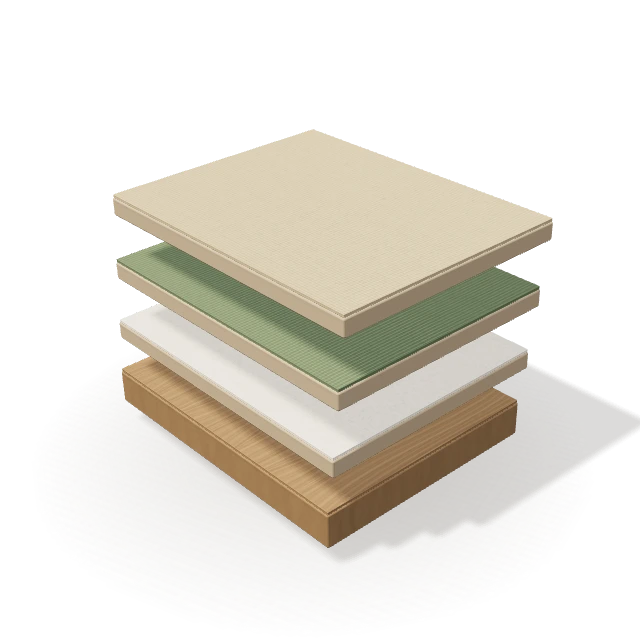
Only if the maker's documents cover it, or a test or assessment report covers that build-up. The designer, fire engineer or building-control body then has to accept it, or, for a building in use where the job is not building work, the responsible person. Hanging over an existing wallcovering adds an untested layer, and makers' instructions generally ask for old wallcoverings to be removed. Lining paper, a different adhesive or a later coating are also changes to the build-up.
Does Mr Wallcover certify the fire rating of what it installs?
No. Classification comes from testing and classification of the product in a stated build-up, and the manufacturer declares the performance. We install the specified product to the maker's instructions and record what was installed. The designer, fire engineer or building-control body accepts the evidence, or, for a building in use where the job is not building work, the responsible person through the fire risk assessment.
Do these rules apply in Scotland, Wales and Northern Ireland?
Wales applies the Building Regulations 2010 as amended for Wales, with its own Approved Document B. Scotland and Northern Ireland have their own building regulations, with the Technical Handbooks and Technical Booklet E as guidance. They use the same European classes, but their tables, terms and amendment dates differ, so check the guidance for where the building is.
Source library
Every document cited on this page, grouped by where it comes from. For standards we link the publisher's catalogue record, which confirms the title and edition; we have not reproduced paid standards. For manufacturers we link their own published documents rather than copying them. The checking date is when we last opened each source.
England
22 documents
- Fire safety: Approved Document B (GOV.UK collection)Ministry of Housing, Communities and Local Government · Government guidance · dated 16 September 2026 (page last updated) · checked 15 October 2026GOV.UK's index of the current Approved Document B volumes and amendment booklets, with the change history.
- Approved Document B: Fire safety, Volume 2: Buildings other than dwellingsMinistry of Housing, Communities and Local Government · 2019 edition incorporating the 2020, 2022, 2025 and 2026 amendments, with the forthcoming 2029 changes; for use in England · Government guidance · dated 16 September 2026 (GOV.UK listing updated) · checked 15 October 2026England's current guidance on wall and ceiling linings in buildings other than dwellings: requirement B2, Section 6, Table 6.1 and its BS EN 15102 wallcovering note, the definitions of walls and ceilings, and Appendix B on reaction-to-fire classes, test evidence and substrates. Guidance on one way of meeting requirement B2, not the law itself. Pages marked as 2029 amendments are not yet in force.
- Approved Document B: Fire safety, Volume 1: DwellingsMinistry of Housing, Communities and Local Government · 2019 edition incorporating the 2020, 2022, 2025 and 2026 amendments, with the forthcoming 2029 changes; for use in England · Government guidance · dated 16 September 2026 (GOV.UK listing updated) · checked 15 October 2026Volume 1 covers dwellings, including blocks of flats. Its Table 4.1 sets B-s3,d2 for other circulation spaces, including the common areas of blocks of flats, with the same BS EN 15102 wallcovering note as Volume 2; C-s3,d2 for other rooms and circulation spaces within a dwelling; and D-s3,d2 for small rooms and dwellinghouse garages. Guidance for England only. The rows for rooms within a dwelling are not the same as Volume 2.
- Approved Document B: Fire safety, Volume 2, 2019 edition incorporating the 2020 amendments and the 2022 amendments (superseded)Ministry of Housing, Communities and Local Government · Superseded edition · Government guidance · dated 2022 · checked 15 October 2026 · supersededThe previous edition, which still applies to work covered by the transitional arrangements. Its Appendix B and Table B1 set out the former national classes and warn that national and European classes do not automatically equate.
- Amendments to Approved Document B, Volumes 1 and 2: taking effect on 2 March 2025Ministry of Housing, Communities and Local Government · 2025 amendments booklet · Government guidance · dated Published September 2024; corrected 2 March 2025 · in force from 2 March 2025 · checked 15 October 2026The removal of national reaction-to-fire classes from England's guidance from 2 March 2025, and the transitional arrangements for work already notified.
- Amendments to Approved Document B, Volumes 1 and 2: taking effect on 30 September 2026Ministry of Housing, Communities and Local Government · 2026 amendments booklet · Government guidance · dated First published March 2024; updated September 2024 · in force from 30 September 2026 · checked 15 October 2026The 2026 changes (second staircases and evacuation lifts in blocks of flats), in force from 30 September 2026. They do not change lining classes.
- Amendments to Approved Document B, Volumes 1 and 2: taking effect on 2 September 2029Ministry of Housing, Communities and Local Government · 2029 amendments booklet · Government guidance · dated September 2024 · takes effect 2 September 2029 · checked 15 October 2026 · forthcomingThe removal of national fire-resistance classes from England's guidance on 2 September 2029, with transitional arrangements. Not in force on the date we checked.
- Approved Document B (fire safety): new updates to support enhanced fire safetyMinistry of Housing, Communities and Local Government · Letter accompanying Circulars 03/2024, 04/2024 and 05/2024 · Government guidance · dated 2 September 2024 · checked 15 October 2026The government's own explanation of the 2025, 2026 and 2029 changes, treating reaction to fire and fire resistance as separate subjects.
- Circular 03/2024: Approved Document B (sprinklers and reaction to fire)Ministry of Housing, Communities and Local Government · Circular 03/2024, 5 pp · Government guidance · dated 2 September 2024 · in force from 2 March 2025 · checked 15 October 2026The circular approving the 2025 amendments, including the removal of the national classification for reaction to fire.
- Circular 05/2024: Approved Document B (fire resistance)Ministry of Housing, Communities and Local Government · Circular 05/2024, 5 pp · Government guidance · dated 2 September 2024 · takes effect 2 September 2029 · checked 15 October 2026 · forthcomingThe circular approving the 2029 amendments on the national classification for fire resistance. Not in force on the date we checked.
- Approved Document B: fire safety, frequently asked questionsMinistry of Housing, Communities and Local Government · Question 18 (field of application of reaction-to-fire classes) · Government guidance · dated 21 February 2025 (page last updated) · checked 15 October 2026Official answers on Approved Document B, including that the same material can achieve different classes in different forms, fixings and substrates, and that variations should be assessed by competent professionals.
- The Building Regulations 2010, Schedule 1, Part B, and regulation 7legislation.gov.uk · SI 2010/2214 · Legislation · checked 15 October 2026The legal requirement for internal linings (requirement B2 in Schedule 1 to the Building Regulations 2010) and regulation 7 on materials.
- The Building Regulations 2010, regulation 3 (meaning of building work)legislation.gov.uk · SI 2010/2214 · Legislation · checked 17 October 2026An alteration is 'material' only if it affects a 'relevant requirement': Part A, B1, B3, B4, B5, Part M or Part T. B2 (internal linings) is not on the list, so redecorating on its own is not normally building work. The text applies in England; Wales has its own amendments to the same regulations (the Welsh Volume 2, paragraph 0.18, gives the same list for Part B).
- Building Act 1984, sections 6 and 7legislation.gov.uk · 1984 c. 55 · Legislation · checked 15 October 2026The status of approved documents: approved under section 6, and under section 7 compliance or non-compliance may be relied on as tending to establish or negative liability.
- Regulatory Reform (Fire Safety) Order 2005, articles 3, 8, 9 and 50legislation.gov.uk · SI 2005/1541 · Legislation · checked 15 October 2026Fire safety in buildings in use in England and Wales, other than inside private homes: the responsible person's duties to take general fire precautions and to keep a fire risk assessment under review, including after significant changes, extensions or conversions (article 9(3)).
- Regulatory Reform (Fire Safety) Order 2005, article 2 (interpretation)legislation.gov.uk · SI 2005/1541 · Legislation · checked 17 October 2026'Domestic premises' means premises occupied as a private dwelling, including appurtenances not used in common by the occupants of more than one dwelling; shared halls and stairs are therefore not domestic premises.
- Regulatory Reform (Fire Safety) Order 2005, article 3 (meaning of "responsible person")legislation.gov.uk · SI 2005/1541 · Legislation · checked 17 October 2026The responsible person is the employer, for a workplace to any extent under its control; otherwise the person who controls the premises for a trade, business or other undertaking; or else the owner.
- Regulatory Reform (Fire Safety) Order 2005, article 5 (duties under the Order)legislation.gov.uk · SI 2005/1541 · Legislation · checked 17 October 2026Anyone else with control of the premises to any extent shares the duties for matters within their control, including anyone whose contract or tenancy gives them an obligation for maintenance, repair or safety.
- Regulatory Reform (Fire Safety) Order 2005, article 6 (application to premises)legislation.gov.uk · SI 2005/1541 · Legislation · checked 17 October 2026The Order does not apply to domestic premises (article 6(1)(a)); in a building with two or more sets of domestic premises it applies to the structure, external walls (including doors, windows and balconies) and common parts, and to the doors between the flats and the common parts (article 6(1A) and (1B), inserted by the Fire Safety Act 2021).
- Fire Safety Act 2021, section 1legislation.gov.uk · 2021 c. 24 · Legislation · checked 17 October 2026Inserts article 6(1A) and (1B) into the Fire Safety Order: in a building with two or more sets of domestic premises, the Order covers the structure, external walls (including doors, windows and balconies) and common parts, and the doors between the flats and the common parts. In force in Wales from 1 October 2021 and in England from 16 May 2022. Applies to England and Wales only.
- Fire safety risk assessment: sleeping accommodationDepartment for Communities and Local Government · Guide published under article 50 of the Fire Safety Order · Government guidance · dated 2006 (reprinted 2015) · checked 15 October 2026Official fire risk assessment guidance for hotels and other sleeping accommodation in England and Wales. It discusses wall and ceiling linings and says care is needed with multi-layer decorative systems such as wallpapers and oil-based paints, in the older national class terms. Written before the European classes replaced the national ones in English guidance; it says the European equivalent is acceptable.
- Fire safety risk assessment: offices and shopsDepartment for Communities and Local Government · Guide published under article 50 of the Fire Safety Order · Government guidance · dated 2006 (reprinted 2015) · checked 15 October 2026The equivalent official guidance for offices and shops. It lists wall and ceiling linings by the older national classes and notes that additional finishes may harm a surface's fire performance. Uses the older national class terms.
Wales
9 documents
- Approved Document B: fire safety (Wales)Welsh Government · Web page · dated 19 June 2025 (page last updated) · checked 15 October 2026The Welsh Government's index of Approved Document B for use in Wales and its amendment slips.
- Approved Document B, Volume 2: Buildings other than dwellinghouses (for use in Wales)Welsh Government · 2006 edition incorporating the 2010, 2013, 2016, 2017 and 2020 amendments · Government guidance · dated December 2021 (2020 amendments in force 31 December 2020) · in force from 31 December 2020 · checked 15 October 2026Wales's guidance on wall and ceiling linings: Table 10 with national and European classes, its BS EN 15102 wallcovering note, and Appendix A's definition of Class 0.
- Approved Document B, Volume 1: Dwellinghouses (for use in Wales)Welsh Government · 2006 edition incorporating the 2010, 2016 and 2020 amendments · Government guidance · dated August 2026 (file published) · checked 17 October 2026The Welsh guidance for dwellinghouses, with its own edition label: 2006 edition incorporating the 2010, 2016 and 2020 amendments. Its linings table is not reproduced on the page.
- Amendments to Approved Document B, Volumes 1 and 2, coming into effect 20 December 2025 (Wales)Welsh Government · 13 pp; WG52486 · Government guidance · dated 19 June 2025 · in force from 20 December 2025 · checked 15 October 2026The Welsh amendment slip in force from 20 December 2025. It replaces the external-wall guidance (Volume 1 paras 9.5-9.6; Volume 2 Section 13), replaces Appendix A Table A7 item 8, and adds wayfinding signage, evacuation alert systems and secure information boxes for blocks of flats (Volume 2 paras 18.16-18.24). It does not amend Section 7 or Table 10.
- Building (Amendment) (Wales) Regulations 2025: circular WGC 004/2025Welsh Government · WGC 004/2025; SI 2025/704 (W.119) · Government guidance · dated 19 June 2025 · in force from 20 December 2025 · checked 15 October 2026The Welsh circular on the 2025 amendments. It says the proposed move of national classes into an appendix will follow the next revision of Approved Document B.
- Part B (fire safety): summary of responses and Government responseWelsh Government · WG50772; 24 pp · Government guidance · dated 8 January 2025 · checked 15 October 2026The Welsh Government's consultation response: national classes are to move to an appendix rather than be deleted, and full removal would need further research and consultation.
- The Building etc. (Amendment) (No. 2) (Wales) Regulations 2025legislation.gov.uk · SI 2025/1320 (W.) · Legislation · in force from 1 July 2026 · checked 17 October 2026Adds dutyholder and competence duties for building work in Wales (Part 2B of the Building Regulations 2010 as they apply in Wales) and a regulation 38 acknowledgement, from 1 July 2026, with transitional provisions for work already started or notified. Changes procedures and duties, not the lining classes.
- The Building (Higher-Risk Buildings Procedures) (Wales) Regulations 2025legislation.gov.uk · SI 2025/1321 (W.) · Legislation · in force from 1 July 2026 · checked 17 October 2026The building control procedure for higher-risk buildings in Wales, in force from 1 July 2026.
- The Building Safety (Description of Higher-Risk Building) (Design and Construction Phase) (Wales) Regulations 2023legislation.gov.uk · SI 2023/1210 (W.) · Legislation · checked 17 October 2026In Wales, a higher-risk building for design and construction is at least 18 m or seven storeys and contains at least one residential unit, a hospital with an overnight bed, a care home or a children's home (regulation 3); a building comprised entirely of a hotel is excluded (regulation 6).
Scotland
11 documents
- Building standards (collection)Scottish Government · Web page · checked 15 October 2026The Scottish Government's index of the building standards technical handbooks and the dates they apply from.
- Building standards technical handbook: non-domestic, April 2026Scottish Government · Government guidance · dated 9 March 2026 (published) · in force from 6 April 2026 · checked 15 October 2026The current non-domestic handbook, for building warrants submitted on or after 6 April 2026. Standard 2.5 and Table 2.4 cover internal linings; clause 2.5.1 leaves decorative wallpaper and paint out of the classified surface.
- Building standards technical handbook: domestic, April 2026Scottish Government · Government guidance · dated 9 March 2026 (published) · in force from 6 April 2026 · checked 17 October 2026Clause 2.5.1 of the domestic handbook: wall and ceiling surfaces mean the substrate or lining material and exclude decorative wallpaper and paints, which are not controlled by the guidance; multiple layers are not recommended when redecorating. Protected zones A1, A2 or B; rooms, unprotected zones and protected enclosures no worse than C; small rooms and limited wall areas D. The hash is of the publication page; the PDF linked from it was read.
- Building standards technical handbook 2022: non-domestic, section 2.5 Internal liningsScottish Government · Government guidance · dated 2022 · checked 15 October 2026 · supersededThe 2022 handbook's section 2.5, showing that the wallpaper exclusion and Table 2.4 were the same before the 2026 edition.
- The Building (Scotland) Regulations 2004legislation.gov.uk · SSI 2004/406 · Legislation · checked 15 October 2026The Scottish building regulations, whose Schedule 5 contains the standards the handbooks give guidance on.
- Fire (Scotland) Act 2005, section 78legislation.gov.uk · 2005 asp 5 · Legislation · checked 17 October 2026The Part 3 fire safety duties do not apply to domestic premises, which include a stair or passage used in common by the occupants of more than one dwelling; houses that must be licensed as houses in multiple occupation are not domestic premises, so the duties apply to them.
- Fire (Scotland) Act 2005, section 53 (duties of employers)legislation.gov.uk · 2005 asp 5 · Legislation · checked 17 October 2026Each employer must assess the workplace for fire risks and take fire-safety measures.
- Fire (Scotland) Act 2005, section 54 (duties in relation to relevant premises)legislation.gov.uk · 2005 asp 5 · Legislation · checked 17 October 2026Anyone with control of relevant premises to any extent must assess fire risks and take fire-safety measures to that extent; in some cases the owner; and anyone whose contract or tenancy gives them an obligation for maintenance, repair or fire safety.
- Fire Safety (Scotland) Regulations 2006, regulation 24legislation.gov.uk · SSI 2006/456 · Legislation · checked 17 October 2026Applies the duty to maintain measures provided for the protection of firefighters (regulation 23) to the common areas of private dwellings, for persons with control of those areas.
- Building (Scotland) Regulations 2004, regulation 5 (building warrant exemptions)legislation.gov.uk · SSI 2004/406 · Legislation · checked 17 October 2026Work of a kind listed in schedule 3 must meet the standards but does not need a building warrant, subject to the exceptions and conditions.
- Building (Scotland) Regulations 2004, schedule 3 (work not requiring a warrant)legislation.gov.uk · SSI 2004/406 · Legislation · checked 17 October 2026Replacing flooring, lining, covering or rendering, in whole or in part, by material of the same general type, internally or externally, needs no building warrant, on condition that the work is to a standard no worse than at present.
Northern Ireland
11 documents
- Technical Booklet EDepartment of Finance (Northern Ireland) · Web page · checked 15 October 2026The Department of Finance's page for Technical Booklet E and its amendments.
- Technical Booklet E: Fire safetyDepartment of Finance and Personnel (Northern Ireland) · October 2012 · Government guidance · dated October 2012 · in force from 31 October 2012 · checked 15 October 2026Northern Ireland's fire safety guidance as published in 2012, including Table 3.1 with national and European classes for walls and ceilings.
- Technical Booklet E (Fire safety): 2012 edition with amendments incorporated (track-changes version)Department of Finance (Northern Ireland) · Not an up-to-date consolidated version, as the Department notes · Government guidance · dated November 2024 · checked 15 October 2026The booklet with the 2022 (AMD 7) and 2024 (AMD 9, in force 6 May 2025) amendments shown, confirming Table 3.1 is unchanged and has no BS EN 15102 wallcovering note. The Department says it is not an up-to-date consolidated version.
- Amendments booklet AMD 7 (Technical Booklets B, C and E)Department of Finance (Northern Ireland) · AMD 7 · Government guidance · dated April 2022 · in force from 1 April 2022 · checked 15 October 2026Amendment booklet AMD 7, in force from 1 April 2022. No change to the linings table was found.
- Amendments booklet AMD 9 (Technical Booklets E and R)Department of Finance (Northern Ireland) · AMD 9 · Government guidance · dated May 2025 · in force from 6 May 2025 · checked 15 October 2026Amendment booklet AMD 9, in force from 6 May 2025. No change to the linings table was found.
- Fire and Rescue Services (Northern Ireland) Order 2006, article 50legislation.gov.uk · SI 2006/1254 (N.I. 9) · Legislation · checked 17 October 2026The fire-safety duties apply to 'relevant premises', which exclude domestic premises. Domestic premises include a stair or passage shared by the occupants of more than one dwelling. A house in multiple occupation is not domestic premises, so the duties apply to it.
- Fire and Rescue Services (Northern Ireland) Order 2006, article 25 (duties of employers)legislation.gov.uk · SI 2006/1254 (N.I. 9) · Legislation · checked 17 October 2026Each employer must assess the workplace for fire risks and take fire-safety measures.
- Fire and Rescue Services (Northern Ireland) Order 2006, article 26 (duties in relation to relevant premises)legislation.gov.uk · SI 2006/1254 (N.I. 9) · Legislation · checked 17 October 2026Anyone with control of relevant premises to any extent, in some cases the owner, and anyone whose contract or tenancy gives them an obligation for maintenance, repair or fire safety, must assess fire risks and take fire-safety measures to that extent.
- Fire Safety Regulations (Northern Ireland) 2010, regulation 24legislation.gov.uk · SR 2010/325 · Legislation · checked 17 October 2026Applies the duty to maintain measures provided for the protection of firefighters (regulation 23) to the common areas of private dwellings, for persons with control of those areas.
- Building Regulations (Northern Ireland) 2012, regulation 2 (interpretation)legislation.gov.uk · SR 2012/192 · Legislation · checked 17 October 2026'Building work' includes a structural alteration, meaning any work (other than erection or a service or fitting) to which the regulations would apply if it were part of a new building.
- Building Regulations (Northern Ireland) 2012, regulation 34 (internal fire spread: linings)legislation.gov.uk · SR 2012/192 · Legislation · checked 17 October 2026Internal linings must offer adequate resistance to the spread of flame over their surfaces and, in circulation spaces, have a low rate of heat release or fire growth.
Great Britain and the UK
5 documents
- Construction Products Regulation in Great BritainDepartment for Business and Trade · gov.uk detailed guide · Government guidance · dated 21 May 2025 (last changed) · checked 15 October 2026How construction products are marked and declared in Great Britain: UKCA, and CE marking, which continues to be recognised, with a declaration of performance for products covered by a designated standard.
- Construction Products Regulation in Northern IrelandDepartment for Business and Trade · gov.uk detailed guide · Government guidance · dated 21 May 2025 (last changed) · checked 15 October 2026The equivalent rules for Northern Ireland, where products follow EU harmonised standards and carry CE or CE with UK(NI) marking; UKCA alone is not accepted.
- Construction Products Reform White PaperMinistry of Housing, Communities and Local Government · CP 1515 · Government guidance · dated 25 February 2026 · checked 15 October 2026The government's 2026 proposals for construction products, which describe UKCA and CE markings as a manufacturer's claim of conformity with declared performance, not a safety mark or an assurance of suitability for a particular use. Proposals; not law.
- Notice of publication 0123/25: references to standards for construction productsMinistry of Housing, Communities and Local Government · Notice 0123/25 · Government guidance · dated 26 September 2025 · checked 15 October 2026The GB list of designated standards for construction products, which cites BS EN 15102:2007+A1:2011 for decorative wallcoverings.
- Regulation (EU) No 305/2011 as it has effect in Great Britain, Article 6legislation.gov.uk · Article 6(3)(f) · Legislation · dated 9 March 2011 (revised GB text) · checked 15 October 2026What a declaration of performance must contain, including the letters NPD (no performance determined) where no performance is declared for a characteristic.
Standards (catalogue records)
14 documents
- BS EN 13501-1 landing page (undated, all editions)BSI · UPI 000000000030059106 · Standard: catalogue record · dated 14 January 2019 (BSI page, for the 2018 edition) · checked 15 October 2026BSI catalogue record for BS EN 13501-1 and its editions: 2018 current; 2007+A1:2009 withdrawn in January 2019. A catalogue record confirms title, edition and status only; it does not reproduce the standard.
- BS EN 13501-1:2018 BSI Knowledge recordBSI · BS EN 13501-1:2018 · Standard: catalogue record · dated 31 January 2019 (BSI Knowledge) · checked 15 October 2026BSI Knowledge record for BS EN 13501-1:2018, current. A catalogue record confirms title, edition and status only; it does not reproduce the standard.
- BS EN 13823:2020+A1:2022 BSI Knowledge recordBSI · BS EN 13823:2020+A1:2022 · Standard: catalogue record · dated 31 January 2023 (BSI Knowledge) · checked 15 October 2026BSI Knowledge record for BS EN 13823:2020+A1:2022, the single burning item test. A catalogue record confirms title, edition and status only; it does not reproduce the standard.
- BS EN ISO 11925-2:2026 BSI Knowledge recordBSI · BS EN ISO 11925-2:2026 · Standard: catalogue record · dated 31 January 2026 (BSI Knowledge) · checked 15 October 2026BSI Knowledge record for BS EN ISO 11925-2:2026, the single-flame ignitability test. A catalogue record confirms title, edition and status only; it does not reproduce the standard.
- BS EN ISO 1182:2020 BSI Knowledge recordBSI · BS EN ISO 1182:2020 · Standard: catalogue record · dated 30 June 2020 (BSI Knowledge) · checked 15 October 2026BSI Knowledge record for BS EN ISO 1182:2020, the non-combustibility test. A catalogue record confirms title, edition and status only; it does not reproduce the standard.
- BS EN ISO 1716:2018 BSI Knowledge recordBSI · BS EN ISO 1716:2018 · Standard: catalogue record · dated 31 July 2018 (BSI Knowledge) · checked 15 October 2026BSI Knowledge record for BS EN ISO 1716:2018, the gross heat of combustion test. A catalogue record confirms title, edition and status only; it does not reproduce the standard.
- BS EN 15102:2019 Decorative wallcoverings. Roll form: BSI Knowledge recordBSI · BS EN 15102:2019 · Standard: catalogue record · dated 30 June 2019 (BSI Knowledge) · checked 15 October 2026BSI Knowledge record for BS EN 15102:2019, decorative wallcoverings in roll form, current at BSI. A catalogue record confirms title, edition and status only; it does not reproduce the standard.
- BS EN 15102:2007+A1:2011 Decorative wall coverings. Roll and panel form: BSI Knowledge recordBSI · BS EN 15102:2007+A1:2011 · Standard: catalogue record · dated 30 November 2007 (BSI Knowledge) · checked 15 October 2026BSI Knowledge record for BS EN 15102:2007+A1:2011, roll and panel form, which BSI shows as withdrawn in June 2019. A catalogue record confirms title, edition and status only; it does not reproduce the standard.
- BS EN 13238:2026 BSI Knowledge recordBSI · BS EN 13238:2026 · Standard: catalogue record · dated 31 July 2026 (BSI Knowledge) · checked 15 October 2026BSI Knowledge record for BS EN 13238:2026, conditioning and the selection of substrates; the 2010 edition was withdrawn in August 2026. A catalogue record confirms title, edition and status only; it does not reproduce the standard.
- BS EN 15725:2023 Extended application on the fire performance of construction products and building elements: Principle of EXAP standards and EXAP reportsBSI · BS EN 15725:2023 · Standard: catalogue record · dated 31 March 2023 · checked 15 October 2026BSI Knowledge record for BS EN 15725:2023, extended application of fire performance. A catalogue record confirms title, edition and status only; it does not reproduce the standard.
- BS EN 13501-2:2023 BSI Knowledge recordBSI · BS EN 13501-2:2023 · Standard: catalogue record · dated 30 June 2023 (BSI Knowledge) · checked 15 October 2026BSI Knowledge record for BS EN 13501-2:2023, fire resistance classification of building elements. A catalogue record confirms title, edition and status only; it does not reproduce the standard.
- BS 476-6:1989+A1:2009 Method of test for fire propagation for productsBSI · BS 476-6:1989+A1:2009 · Standard: catalogue record · dated 31 March 1989 · checked 15 October 2026BSI Knowledge record for BS 476-6:1989+A1:2009, fire propagation, withdrawn on 4 March 2025. A catalogue record confirms title, edition and status only; it does not reproduce the standard.
- BS 476-7:1997 Method of test to determine the classification of the surface spread of flame of productsBSI · BS 476-7:1997 · Standard: catalogue record · dated 15 January 1997 · checked 15 October 2026BSI Knowledge record for BS 476-7:1997, surface spread of flame, withdrawn on 4 March 2025. A catalogue record confirms title, edition and status only; it does not reproduce the standard.
- The changing status of the BS 476 standard series: A summary (BSI Knowledge article)BSI · BSI Knowledge article, 19 Feb 2025 · Web page · dated 19 February 2025 · checked 15 October 2026BSI's own summary of the changing status of the BS 476 series and its removal from England's guidance. A BSI explanatory article; it reports status changes and is not the standard.
European classification rules
3 documents
- Commission Delegated Regulation (EU) 2016/364 on the classification of the reaction to fire performance of construction productsEuropean Commission (text on legislation.gov.uk) · Annex, Table 1 · EU legislation · dated Adopted 1 July 2015; published 15 March 2016 · checked 15 October 2026The legal definitions of the reaction-to-fire classes A1 to F and the smoke (s1 to s3) and droplet (d0 to d2) subclasses, with the test criteria for each.
- Commission Decision 2010/82/EU establishing the classes of reaction-to-fire performance for decorative wallcoverings without further testingEuropean Commission (text on legislation.gov.uk) · Decision 2010/82/EU · EU legislation · dated 9 February 2010 · checked 15 October 2026The list of decorative wallcoverings that may be classed D-s3,d2 without further testing, within stated limits of mass, thickness, substrate and adhesive.
- Summary list of harmonised standards under Regulation (EU) No 305/2011European Commission · Commission summary list, 9.2.2026 · Government guidance · dated 9 February 2026 (generated) · checked 15 October 2026The European Commission's summary list of harmonised standards, which cites EN 15102:2007+A1:2011 for decorative wallcoverings.
Other systems
5 documents
- ASTM E84-26a: Standard Test Method for Surface Burning Characteristics of Building MaterialsASTM International · ASTM E84-26a · Standard: catalogue record · dated 15 April 2026 (store page last updated) · checked 15 October 2026ASTM's catalogue record for E84, the US tunnel test that reports flame spread and smoke developed indices. A catalogue record only. A US test, not a European class.
- Resolution MSC.307(88): International Code for Application of Fire Test Procedures, 2010 (FTP Code)International Maritime Organization · Part 5 · International code · dated 3 December 2010 · checked 15 October 2026The IMO's 2010 Fire Test Procedures Code, whose Part 5 is a marine surface-flammability test with its own criteria. Marine approval system; not a building classification.
- BS 5852:2006 Methods of test for assessment of the ignitability of upholstered seating by smouldering and flaming ignition sourcesBSI · BS 5852:2006 · Standard: catalogue record · dated 31 March 2006 · checked 15 October 2026BSI catalogue record for BS 5852:2006, ignitability of upholstered seating: not a wallcovering test.
- BS 5867-2:2008 Fabrics for curtains, drapes and window blinds. Flammability requirements. SpecificationBSI · BS 5867-2:2008 · Standard: catalogue record · dated 30 May 2008 · checked 15 October 2026BSI catalogue record for BS 5867-2:2008, flammability of curtain fabrics: not a wallcovering test.
- BS EN 13773:2003 Textiles and textile products. Burning behaviour. Curtains and drapes. Classification schemeBSI · BS EN 13773:2003 · Standard: catalogue record · dated 19 February 2003 · checked 15 October 2026BSI catalogue record for BS EN 13773:2003, classification of curtains and drapes: not a wallcovering test.
Manufacturers’ documents
53 documents
- Declaration of performance CPR0003, version 4Muraspec · Declaration of performance · dated 4 July 2025 (signed) · checked 15 October 2026Muraspec's 2025 declaration of performance covering several fabric-backed and paper-backed vinyl types, each declared B-s2,d0 on fibre-cement board with Murabond Heavy adhesive.
- Declaration of performance CPR0004, version 1Muraspec · Declaration of performance · dated 4 September 2024 (signed) · checked 15 October 2026Muraspec's declaration for woven Type I fabric-backed vinyl at 360 gsm, declared B-s1,d0 on fibre-cement board with Murabond Heavy adhesive.
- Declaration of performance CPR0003, version 1 (digital print bases)Muraspec · Declaration of performance · dated 4 September 2024 (signed) · checked 15 October 2026Muraspec's 2024 declaration for two digitally printed fabric-backed vinyl bases, declared B-s2,d0 on fibre-cement board with Murabond Heavy adhesive.
- Declaration of performance CPR0005, version 1Muraspec · Declaration of performance · dated 4 September 2024 (signed) · checked 15 October 2026Muraspec's declaration for rotary-screen printed non-woven, non-PVC wallcovering at 200 gsm, declared B-s1,d0 on fibre-cement board with Murabond Heavy adhesive.
- Hanging information leaflet (UK)Muraspec · Technical data sheet · dated May 2026 · checked 15 October 2026Muraspec's hanging instructions, including adhesive choice by wall type and the instruction not to hang over expanded polystyrene veneer.
- Product page: Buflon Mousse Anafi (BM-61527103)Muraspec · Web page · checked 15 October 2026A Muraspec product page that states Euroclass C S3 D0 for an acoustic foam vinyl.
- Product page 13602 (Frequency)Muraspec · Web page · checked 15 October 2026Muraspec's product page for Frequency 13602, which gives 'Certificate of Performance: CPR0004' and 'Weight: 460gsm'. A web page; it gives no class or build-up of its own.
- Technical specification: GeometricsTektura · Technical data sheet · checked 15 October 2026Tektura's combined technical sheet for Geometrics digital prints, window graphics and acoustic panels; its wallcovering fire line reads Euro classification B when adhered to a suitable substrate. No date printed; the file name refers to 2024.
- Technical specification: Dimity WeaveTektura · Technical data sheet · checked 15 October 2026Tektura's technical sheet for Dimity Weave, printing B s1 d0.
- Dimity Weave product pageTektura · Web page · checked 15 October 2026Tektura's Dimity Weave product page, which tags the fire rating 'Euroclass B' and 'Marine (please enquire)'. Gives no subclasses, report, substrate or adhesive.
- Technical specification: RivuletTektura · Technical data sheet · checked 15 October 2026Tektura's technical sheet for Rivulet, printing B s2 d0.
- Rivulet product pageTektura · Web page · checked 15 October 2026Tektura's Rivulet product page, which tags the fire rating 'Euroclass B' and 'Marine (please enquire)'. Gives no subclasses, report, substrate or adhesive.
- Technical specification: ShimmyTektura · Technical data sheet · checked 15 October 2026Tektura's technical sheet for Shimmy, printing C-s1-d0. No date printed; upload path dated 2025-08-14.
- Technical specification: TempleTektura · Technical data sheet · checked 15 October 2026Tektura's technical sheet for Temple, printing Euroclass B. No date printed; upload path dated 2026-08-25.
- Product page: TempleTektura · Web page · checked 15 October 2026Tektura's Temple product page, which tags the product Euroclass C.
- Technical specification: Tiburon ShagreenTektura · Technical data sheet · checked 15 October 2026Tektura's technical sheet for Tiburon Shagreen, printing Euroclass B and BS 476 Class 0 and 1 when adhered to a suitable substrate. No date printed; upload path dated 2026-08-20.
- Classification of reaction to fire performance: vinyl wallcovering 350 g/m²Efectis Nederland · Classification report · dated August 2023 · checked 15 October 2026Classification report on a plain white 350 g/m² Vescom vinyl: B-s1,d0 on 12 mm calcium silicate board with Vescom 3000.
- Declaration of performance DOP-CPR-01006Vescom · Declaration of performance · dated 25 August 2023 · checked 15 October 2026Vescom's declaration of performance for 350 g/m² cotton-backed vinyl.
- Declaration of performance DOP-CPR-01001Vescom · Declaration of performance · dated 27 August 2024 · checked 15 October 2026Vescom's family declaration for cotton-backed FR vinyl of 360 to 850 g/m², declared B-s2,d0.
- Certificate of constancy of performance 0493-CPR-W014, with annexCentexbel · Certificate · dated 5 March 2021 · stated expiry 31 July 2023 · checked 15 October 2026The 2021 certificate of constancy of performance behind Vescom's vinyl family declaration, with its field of application (excluding plasterboard) and a printed validity date.
- Specsheet: Colour Choice+ProtectVescom · Technical data sheet · checked 15 October 2026Vescom's specsheet for Colour Choice+Protect, printing B s2 d0 with no test details.
- Product page: Colour Choice+ProtectVescom · Web page · checked 15 October 2026Vescom's Colour Choice+Protect product page and its linked documents.
- Classification report DO-18-0159\A-R1 (Vescom Rainy)CREPIM · Classification report · dated 21 August 2018 · stated expiry 21 August 2023 · checked 15 October 2026The classification report linked from the Colour Choice+Protect page; it describes a Vescom vinyl called Rainy, without a Protect layer, as B-s2,d0, and is printed as valid for five years from 21 August 2018.
- Declaration of performance DOP-CPR-01002 (vinyl wallcovering with Vescom Protect, 370–480 g/m²)Vescom · DOP-CPR-01002 · Declaration of performance · dated 7 July 2017 · checked 15 October 2026Vescom's Protect family declaration: cotton-backed vinyl with Vescom Protect, FR treated, 370–480 g/m², System 1, B-s2,d0, citing Centexbel certificate 0493-CPR-W015. A family declaration over a mass range; it names no substrate or adhesive.
- Certificate of constancy of performance 0493-CPR-W015 (Vescom vinyl wallcovering with Vescom Protect)Centexbel · 0493-CPR-W015 · Certificate · dated 29 July 2021 (first issued 7 July 2017) · stated expiry 31 July 2023 · checked 15 October 2026Certificate W015: vinyl 310 g/m², cotton 40 g/m² and Protect laminate 20 g/m² (370 g/m² in all), B-s2,d0 on calcium silicate with Vescom 2000 and vertical joints. Its annex cites MPA Dresden classification 20180730/01 of Pleso + Protect, limited to the tested 356 g/m² and 0.31 mm and excluding gypsum boards. States it is valid 'latest on July 31st 2023'. No Protect test at about 460 g/m² is included.
- Classification of reaction to fire performance: Porak+printEfectis Nederland · Classification report · dated January 2025 · checked 15 October 2026Classification report on Porak+print: B-s2,d0 on an A1/A2 board with Vescom 2500.
- Reaction to fire classification report 22965F: woven textile quality 69-2341Warringtonfire (Ghent) · Classification report · dated October 2023 · checked 15 October 2026Classification report on a woven textile quality (69-2341) on paper backing: B-s1,d0, excluding paper-faced plasterboard.
- Declaration of performance DOP-CPR-13008Vescom · Declaration of performance · dated 1 January 2023 · checked 15 October 2026Vescom's declaration for digitally printed one-layer non-woven, declared B-s1,d0.
- Declaration of performance DoP-CPR-24-3959 (UK): Moire SauvageArte NV · Declaration of performance · dated 21 June 2024 · checked 15 October 2026Arte's UK declaration of performance for Moire Sauvage (14 references), declared B-s2,d0.
- Certificate of constancy of performance 0493-CPR-W038Centexbel · Certificate · dated First issued 27 July 2023; current version signed 28 July 2026 · stated expiry 28 July 2029 · checked 15 October 2026The certificate behind Arte's contract vinyl family, giving B-s2,d0 glued on fibre-cement with vertical joints for FR vinyls of 451 to 790 g/m², and a printed validity date.
- Specification sheet 47253A (Moire Sauvage)Arte NV · Technical data sheet · checked 15 October 2026Arte's specification sheet for Moire Sauvage 47253A, printing "Fire rating EU B-s2, d0" with no test substrate, test adhesive or report reference.
- Specification sheet 31000 (Le Corbusier Dots)Arte NV · Technical data sheet · checked 15 October 2026Arte's specification sheet for Le Corbusier Dots 31000: wallpaper on non-woven backing, hung with Arte Clearpro or a good quality dispersion adhesive. Installation guidance; it gives no test substrate, test adhesive or report reference.
- Declaration of performance DoP-CPR-15-3350 (UK): Le Corbusier DotsArte NV · Declaration of performance · dated 11 April 2022 · checked 15 October 2026Arte's UK declaration for Le Corbusier Dots (references 31000 to 31039), declared B-s1,d0.
- Certification report 19/721: type 01 non-woven wallcoveringCentexbel · Classification report · dated 18 September 2026 · stated expiry 28 July 2027 · checked 15 October 2026Centexbel's group report for type 01 non-woven wallcoverings: B-s1,d0 with starch glue on substrates of at least 1,350 kg/m³; printed validity date.
- Declaration of performance DoP-CPR-100001000026-00020 (UK): IndienneArte NV · Declaration of performance · dated 2 April 2026 · checked 15 October 2026Arte's UK declaration for six Indienne designs, declared B-s2,d0.
- Certification report 19/720: type 03 vinyl wallcoveringCentexbel · Classification report · dated 18 September 2026 · stated expiry 12 January 2030 · checked 15 October 2026Centexbel's group report for type 03 vinyl wallcoverings: B-s2,d0 with starch glue on dense substrates; printed validity date.
- Declaration of performance DoP-CPR-100003000026-00040/2 (UK): Les Tapisseries 06DArte NV · Declaration of performance · dated 2 April 2026 · checked 15 October 2026Arte's UK declaration for Brocade and Ramage, declared C-s1,d0.
- Certification report 20/1150: type 06D textile wallcoveringCentexbel · Classification report · dated 4 August 2026 · stated expiry 22 December 2029 · checked 15 October 2026Centexbel's group report for type 06D textile wallcoverings: C-s1,d0 with starch glue on dense substrates; printed validity date.
- Certification report 18/667: type 06C textile wallcoveringCentexbel · Classification report · dated 17 June 2026 · stated expiry 19 November 2029 · checked 15 October 2026Centexbel's group report for type 06C textile wallcoverings: D-s1,d0 with starch glue on dense substrates; printed validity date.
- Declaration of performance DoP-CPR-100003000026-00040/5 (UK): Les Tapisseries 06CArte NV · Declaration of performance · dated 2 April 2026 · checked 15 October 2026Arte's UK declaration for Collines, which declares C-s1,d0 while citing report 18/667.
- Classification report 082/BW/22: Premier Nonwoven 460 g/m²CNBOP-PIB · Classification report · dated 20 September 2022 · checked 15 October 2026Classification report on Premier 460 g/m² non-woven vinyl: B-s1,d0 on fibre-cement board, excluding paper plasterboard.
- Test report 27/06068B/01/23: Premier 400 g/m² non-wovenBTTG · Test report · dated 14 February 2023 · checked 15 October 2026Test report on a Premier 400 g/m² non-woven vinyl sample, giving B-s2,d0 as definite and s1 only as probable.
- Classification report 314369: Project paper-backed wallcoveringExova Warringtonfire · Classification report · dated 25 May 2012 · checked 15 October 2026Classification report on Project paper-backed vinyl: B-s2,d0 on dense fibre-cement board, excluding paper-faced plasterboard.
- Declaration of performance CPR0001, version 3Muraspec · Declaration of performance · dated 4 September 2024 (signed) · checked 15 October 2026Muraspec's 2024 declaration covering several fabric-backed vinyl and textile types, including woven fabric-backed vinyl of 360 to 460 gsm, declared B-s2,d0 on fibre-cement board with Murabond Heavy adhesive. Its listed certificates carry printed expiry dates from December 2026 to March 2027. Signed the same day (4 September 2024) as declaration CPR0004 version 1, which declares B-s1,d0 for woven Type I 360 gsm fabric-backed vinyl; this declaration gives B-s2,d0 for woven fabric-backed vinyl of 360 to 460 gsm. Neither says it replaces the other.
- Declaration of performance CPR0001, January 2021Muraspec · CPR0001 (January 2021) · Declaration of performance · dated January 2021 · checked 15 October 2026 · supersededAn earlier version of declaration CPR0001. Its product-type table lists no acoustic or foam vinyl. Later versions exist (version 3, September 2024).
- Declaration of performance CPR0002, version 3Muraspec · Declaration of performance · dated 4 September 2024 (signed) · checked 15 October 2026Muraspec's 2024 declaration for paper-backed vinyl and Type II non-woven fabric-backed vinyl, declared B-s1,d0 on fibre-cement board with Murabond Heavy adhesive. Whether it has been withdrawn or replaced by the 2025 CPR0003 is not stated.
- How do fire ratings work? (Muraspec article)Muraspec · Web page · dated 23 October 2023 (published) · checked 15 October 2026Muraspec's general article on fire ratings, which describes its wallcoverings as class B. A marketing article, not a declaration or classification; individual product documents differ.
- Classification report 2012-Efectis-R9438d: Vescom vinyl about 460 g/m² on paper-faced plasterboardEfectis Nederland · Classification report · dated November 2012 · checked 15 October 2026A 2012 classification of a Vescom 460 g/m² vinyl as B-s2,d0, tested on paper-faced plasterboard with Vescom 2000, under the 2007+A1:2009 edition of EN 13501-1. Filed under design names the report does not mention.
- Declaration of performance DOP-CPR-13004: woven animal and synthetic fibre textiles on paper backingVescom · Declaration of performance · dated 1 January 2024 · checked 15 October 2026Vescom's declaration for this textile family, declared B-s1,d0 under System 3 and citing classification report 22965F.
- General specifications for use: Vescom vinyl, olefin and textile wallcovering (2025)Vescom · Installation instructions · dated 2025 · checked 15 October 2026Vescom's general hanging instructions, which ask for existing wallcoverings and backing papers to be removed.
- ASTM E84 test report 13-03217 (a vinyl substrate submitted by another company), linked from Arte pages as the US Class A certificateCommercial Testing Company · Test report · dated 26 March 2013 · checked 15 October 2026A 2013 US tunnel-test report on a different vinyl product, which Arte links as the US fire certificate for its contract vinyls. A US test, not a European class, and not a test of Moire Sauvage.
- Test report 27/06093/02/23: Premier 20oz non-woven-backed vinylBTTG · Test report · dated 8 March 2023 · checked 15 October 2026A 2023 test report on a Premier 20 oz non-woven-backed vinyl sample (no weight in g/m² is printed; Newmor files it as 460gsm Type II non-woven), giving B, s2, d0. Whether this is the same construction as the sample in report 082/BW/22 is not established.
- Can I install wallcovering over existing wallcovering? PVC on PVC (Dreamscape support article)Dreamscape · Web page · dated 7 October 2024 (modified) · checked 15 October 2026A vinyl wallcovering maker states that installing vinyl over an existing wallcovering voids the product fire rating, and that it has no test data for a double layer. One maker speaking about its own products; check each maker’s own guide.
Your next step
Discuss your wallcovering specification.
Send the product references, the rooms or areas they are for, and the fire requirement each area carries, if you know it. We will tell you which documents the maker publishes for that product, what build-up they describe, and the questions to put to the maker and the project's fire specialist before anything is ordered. We do not confirm whether a product meets your requirement.
Related: hotel wallcovering specification · developer wallcovering package · for designers · for hotels · contract vinyl · wall preparation