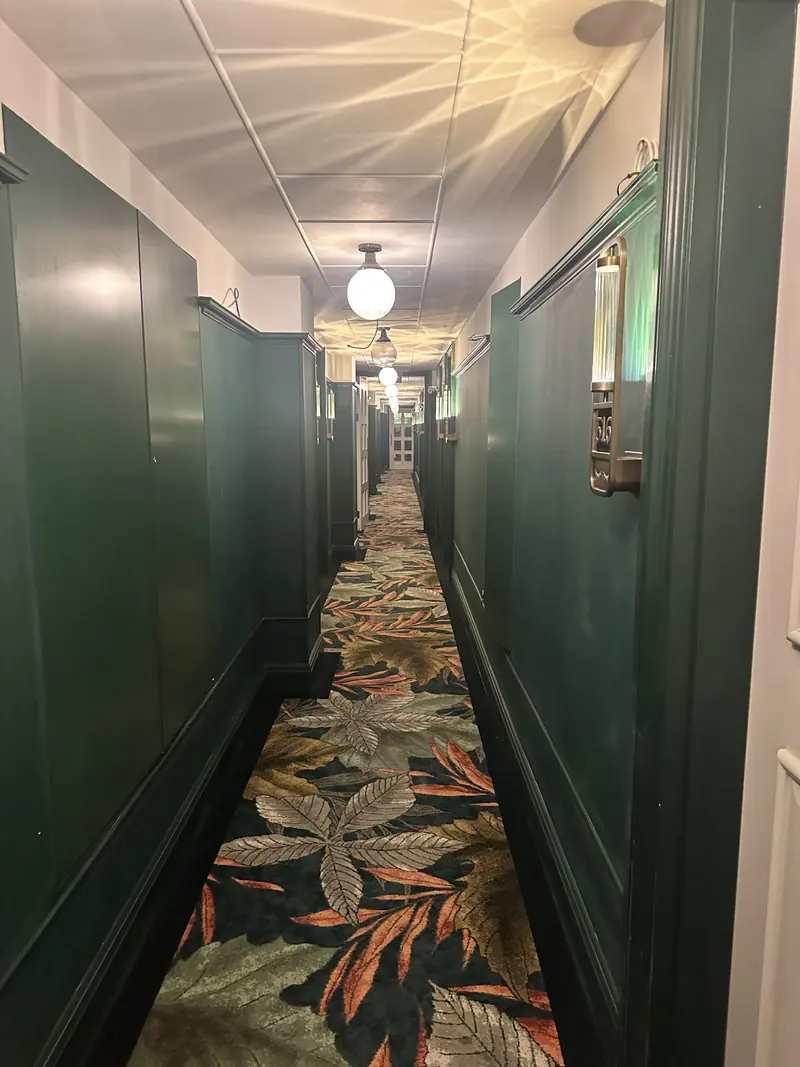
What does wallpaper installation cost? There is no flat rate per roll. The figure follows the measured wall area after openings are taken off, the pattern repeat and the wastage it creates, the state of the walls, the material, and the access and protection the room needs. Two rooms with the same floor area can be quite different days of work: a plain contract vinyl in an empty flat is not a hand-painted scenic in an occupied house, or a hotel corridor that can only be reached between guests. This guide explains each factor so you can compare quotations on the same basis.
How is the area measured?
We measure on site, or from drawings when the programme needs it. Skirting, cornice, joinery, doors and windows come out of the area; what is left is the wall that will actually be hung. The labour measurement is not the same as the purchase quantity: a quotation prices the work, while the order has to cover full drops, the repeat and the batch. Our quantities page explains the difference and why openings rarely save a whole drop.
Why does the pattern repeat cost money?
A large or demanding repeat wastes material at the top of every drop, and a half-drop match wastes more. The allowance is typically 15–30%, depending on the pattern repeat and the layout, with staircases at the high end (around 30%) because of the angles. The repeat also changes the time: each drop is matched by eye, and a room set out around its focal points takes longer than a plain paper run from a corner. At Brown’s Hotel, Adam’s Eden carries a 108.5 cm half-drop repeat, and every room was set out from its chimneypiece, doorcase or bed wall so the pattern sat square to the cornice and the joinery.
What preparation is included?
Installing onto a sound, prepared surface is one job. Stripping old coverings, repairing damage, filling, sanding and lining an uncertain substrate is another, and it can be the larger part of the time on a period wall. A useful quotation says what preparation is included, what is subject to inspection once the old paper is off, and how extra work would be authorised. Lining usually means another visit, because the liner has to dry before the finish goes on (Farrow & Ball asks for at least 12 hours), so a price that is silent on lining is not comparable with one that includes it. Our wall preparation guide lists what has to be checked.
How does the material change the work?
A product code is more useful than a description, because the code decides the labour: trimmed or untrimmed edges, paste-the-wall or paste-the-paper, a lining or none, drops shaded dry before hanging, a panel layout, or the maker’s own adhesive system. Narrow printed rolls, wide contract vinyl, natural weaves that need clean hands and a particular adhesive, delicate silks, and bespoke scenic panels each introduce different handling, set-out and risk. Some are specified over a lining, some are not. A hand-painted scenic is priced by the panel sequence and the time to set it out, not by the roll. Where you have not yet chosen the material, say so: it is a normal starting point, not a reason to guess.
What about access, protection and the awkward parts?
Stair access, high walls, deep reveals, small returns, paper on joinery and junctions with cornice or panelling can matter as much as the large flat areas. Protection of floors, furniture and finished joinery is part of the hang (how a project is run), and in an occupied home or a working hotel the work has to be contained and tidied daily. Limited working hours, night working or room-release sequences all belong in the scope from the start; our hotel specification guide covers how a phased programme is planned.
What should a complete quotation include?
Check whether a price includes the survey, preparation, lining and primers, adhesive, protection, access equipment, waste removal, and the aftercare visit. Material supply and installation should be shown separately, so a paper you or your designer supply (free-issue) and a sourced one are comparable. Parking, travel and VAT treatment should be clear. A low headline rate is not a useful comparison if essential work sits outside it; a premium price needs a clear scope rather than vague promises.
What this guide cannot tell you
It cannot tell you what your room will cost, because it has not seen your room. Exterior work, listed buildings, acoustic systems and anything with a fire or specification requirement need their own scope. For a first discussion, send the location, room photographs, approximate dimensions, the product reference if you have one, whether it is already ordered and from one batch, and your preferred timing. The most useful photographs show each wall square-on, a stair from below and from the landing, the ceiling height, and the way into the building: lift, common parts or parking. Developers and main contractors tendering a package will find the measurement basis and scope matrix in our developer package guide.
Ready to ask for a quotation? Our wallpaper quotation checklist brings the room, material, access and timing information together. Leave unknown details open for the survey.